
There was a time when the most important object on a computer desk was not the computer itself, but the floppy disk sitting beside it. The computer was the expensive centrepiece, the thing with the glowing screen and the humming power supply, but the disk was where the work actually lived. It was the small square that carried a school essay across town, moved a spreadsheet from one office machine to another, installed a game on a Saturday afternoon, or held the only copy of a half-finished novel written late at night. To remember the floppy disk properly, it helps to forget what storage feels like now. Today, files drift invisibly between phones, laptops, servers, and cloud accounts. We save without thinking. Before cloud storage, USB sticks, and download links, your digital life often lived on a fragile plastic disk. In the 1980s and 1990s, four names battled for users’ trust: Verbatim, Maxell, Sony, and 3M. Their rivalry was not just about storage capacity or price. It was about confidence, reliability, and the fear that one bad disk could erase hours, days, or even years of work.
A world saved on plastic
There was a time when the most important object on a computer desk was not the computer itself, but the floppy disk sitting beside it. Thin, square, easily lost, and usually labelled by hand, the floppy carried homework, invoices, games, letters, programs, payroll files, unfinished novels, and family documents. It was small enough to slip into a pocket, but important enough to ruin your day if it failed.
That fear created a serious business. To ordinary buyers, one disk looked much like another, but to the companies making them, each disk was a promise. Better coating, cleaner manufacturing, safer storage, fewer errors, longer life. The floppy disk was cheap, but the data on it was not.
A floppy disk was not just a storage product. It was an act of trust. When users bought a box of disks, they were really buying confidence that the file would still open tomorrow, next week, or months later when it suddenly mattered again. That made branding unusually powerful, because a good name on the label could calm a very real fear: data loss.
Verbatim: the specialist
Verbatim understood the emotional side of storage better than most. Its famous DataLife branding was simple but effective because it did not speak only to engineers or office buyers. It suggested that your data had a life of its own, and that Verbatim existed to protect it from the small disasters of everyday computing.
That message worked because floppy disks lived dangerous lives. They were thrown into bags, left on desks, touched by careless fingers, exposed to dust, heat, coffee, and magnets. A disk might cost little, but a lost file could mean hours of work gone forever. Verbatim built its reputation around reliability, and for many users it felt like the serious choice: the disk for people who labelled everything carefully, made backups, and did not want surprises.
In a crowded market, Verbatim’s great achievement was making a commodity feel professional. It gave buyers the sense that storage media could be chosen carefully, not just grabbed from the cheapest box on the shelf.
Verbatim’s personality was careful, technical, and dependable. It appealed to programmers, office users, and serious home-computer owners who wanted their disks to feel like a safe place for important work. Its central promise was simple: your data deserves protection. That promise helped make Verbatim one of the strongest names in removable media.
3M: the trusted heavyweight
If Verbatim was the specialist, 3M was the industrial giant. The company already had a reputation for materials, coatings, tapes, and precision manufacturing, which gave its floppy disks instant credibility. 3M sounded like a company that knew how to make magnetic media properly, and in the floppy era that kind of reputation mattered.
Its disks were often marketed with the language of testing and certainty. That appealed especially to offices, schools, institutions, and businesses buying disks in bulk. For home users, packaging might have mattered, but for a company ordering hundreds or thousands of disks, reliability mattered more. A failed disk was not just annoying. It could interrupt work, delay a project, or create an expensive support problem.
3M’s strength was authority. It did not need to be flashy. The name itself suggested quality control, laboratories, and careful production. In the floppy wars, 3M was the brand that seemed to say it knew exactly what it was doing.
3M’s personality was corporate, reliable, and industrial. It appealed to businesses, schools, institutions, and professional users who wanted tested quality at scale. Its legacy is tied to dependability, especially among people who remember buying disks not as a novelty, but as essential office supplies.
Sony: the format king
Sony’s role was different because it did not simply sell floppy disks. It helped define what the modern floppy disk looked like. The 3.5-inch disk, with its hard plastic shell and sliding metal shutter, felt like a leap forward. Compared with the older 5.25-inch floppy, it was sturdier, neater, and easier to carry. It felt less like a delicate sleeve and more like a proper cartridge.
That design changed everything. Once major computer makers adopted the 3.5-inch format, Sony had won something bigger than shelf space. It had won the standard. By the 1990s, the 1.44 MB high-density floppy was everywhere: in PCs, Macs, offices, schools, software boxes, and magazine cover disks. For many users, the Sony-style 3.5-inch disk became the floppy disk.
Even after the physical disks disappeared from most desks, the image remained. The save icon still resembles the format Sony helped make famous. That may be the most unusual victory in the whole story. Sony’s disk became obsolete, but its silhouette became immortal.
Sony’s personality was modern, precise, and format-defining. It appealed to PC and Mac users, mainstream consumers, and electronics buyers who trusted Sony’s reputation for compact, well-designed technology. Its greatest legacy is not simply that it sold disks, but that the 3.5-inch disk became the visual symbol of saving.
Maxell: the stylish contender
Maxell entered the floppy market with cultural credibility. Many buyers already knew the name from audio cassettes and videotapes, where Maxell meant recording quality. It belonged to music collections, hi-fi systems, mixtapes, and home entertainment. That gave the brand a cooler, more consumer-friendly feel than some of its rivals.
A Maxell floppy disk suggested that data storage could share the same values as audio recording: fidelity, durability, and performance. It was not just an office product. It felt connected to a wider world of personal media, where people trusted magnetic tape to hold songs, films, memories, and information.
Maxell also became part of one of the more interesting alternative paths in floppy history: the 3-inch compact floppy. The format was solid and well protected, and it found a following in some home computers, especially in Europe. But standards decide winners. Sony’s 3.5-inch format became dominant, while the 3-inch disk became a fascinating side story. Maxell remained a respected name, but it did not control the shape of the floppy future.
Maxell’s personality was stylish, consumer-friendly, and media-savvy. It appealed to home users, audio and video loyalists, and computer hobbyists who already trusted the brand from other recording formats. Its legacy is strong brand recognition and a distinctive place in the culture of magnetic media, even if it did not win the most important standards battle.
The battle on the shop shelf
The real war happened in computer shops, office-supply stores, school purchasing departments, and mail-order catalogues. Boxes of disks competed with bold promises: high density, double density, formatted, unformatted, certified, lifetime warranty, error-free, IBM compatible, Mac compatible. The language was technical, but the emotional message was always the same. Buy these disks and your work will be safe.
Some users bought the cheapest box. Others were loyal to a brand. Many had superstitions. One person would swear by Verbatim, another trusted 3M, a Sony user might insist the original format maker knew best, and a Maxell fan might stick with the brand they already trusted for tapes. The differences were sometimes technical, but often they were emotional. Everyone who used floppies eventually learned the same lesson: make a backup.
Few computer sounds were more stressful than a floppy drive struggling to read a bad disk. The repeated clicking, grinding, and retrying could turn a calm afternoon into panic. One moment your work was safe, and the next the computer was telling you the disk could not be read. That sound is part of computing history because it captured the fragility of the whole era.
Why the floppy mattered
The floppy disk helped make personal computing practical. It allowed software to be sold in shops, let users move files between machines, made backups possible, and helped students take work to school, workers take files home, and hobbyists share programs with friends. It was physical, portable, and understandable in a way that later storage systems often were not.
You could see your data. You could hold it. You could put it in a box, write on it, lend it, lose it, damage it, or hide it in a drawer. That made computing feel more personal. Before the internet became ordinary, the floppy was the network.
The slow death of the disk
The floppy did not disappear overnight. For years, it survived because it was familiar. Computers had floppy drives, offices had boxes of disks, software still shipped on them, and older equipment still required them. Even when better technology appeared, the floppy remained useful because it was already everywhere.
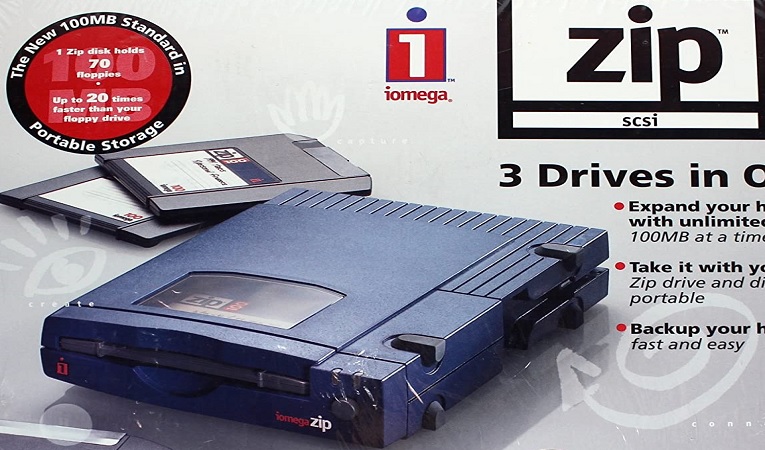
But the pressure was building. CD-Rs offered vastly more space, Zip disks briefly promised a better removable future, external drives became cheaper, email attachments became common, and then USB flash drives arrived and made the floppy feel painfully small. A 1.44 MB disk could not compete with a thumb drive holding hundreds or thousands of times more data. By the early 2000s, the floppy drive was vanishing from new computers. First it seemed bold. Then it seemed inevitable.
Floppies survived because they were everywhere. Even when better options existed, millions of older machines still expected a floppy disk. Industrial equipment, music samplers, embroidery machines, lab systems, and legacy business computers kept the format alive long after ordinary consumers had moved on. Technology does not die when it becomes outdated. It dies when the last machine that needs it is finally replaced.
Who won the brand war?
Sony won the format war. Its 3.5-inch disk became the defining floppy of the modern computer age. Verbatim won the specialist’s reputation by making reliability feel like a serious brand promise. 3M won institutional trust by bringing industrial credibility to a market built on fear of failure. Maxell won cultural style by carrying the glamour of magnetic recording from music into computing.
But none of them won forever. The floppy disk was a bridge between two eras. It connected the world of isolated personal computers to the world of networks, downloads, flash drives, and cloud storage. For a brief and important moment, it was the most ordinary miracle in computing.
Closing thought
Today, the floppy disk is a symbol more than a tool. It survives as the save icon, as retrocomputing treasure, as old stock in forgotten cupboards, and as a memory for anyone who once carried their digital life in a plastic square. The brand names still matter because they remind us of a time when saving a file felt physical. You heard the drive spin. You waited. You hoped. And when the light went off and the disk came out, your work was safe. At least, you hoped it was.
MORE AMIGA & RETRO NEWS
 Eric Graham’s 1987 Amiga Juggler raytracer recovered from original disk image
 Amiga boot viruses explained: SCA, Byte Bandit and disk infection
 ADFlib 0.10.7 improves Amiga disk image handling for ADF and HDF files
 G-Copy 0.8 adds new features for Amiga floppy disk preservation
 Disk Inspector for macOS: a new tool for managing Commodore 64 disk images
 PS3 update 4.93 released: Sony still supporting PlayStation 3 after two decades
 Sega Saturn floppy disk drive: a strange piece of gaming history
 Amiga 880KB disk format explained: tracks, sectors, and engineering choices
 Sony’s new patent could let you play games before they fully download
 Nintendo 64DD history: features, games, and reasons the N64 disk drive failed
 The 3½-inch floppy disk drive: Sony’s most influential hardware release
 The other 68000 computer: how the Atari ST fought the mid-80s giants
 Amiga 500’s Insert Disk hand: the boot screen everyone remembers
 Understanding the clicking sound of an Amiga’s floppy Drive
 Using the legendary Iomega’s Zip drive on the Amiga