
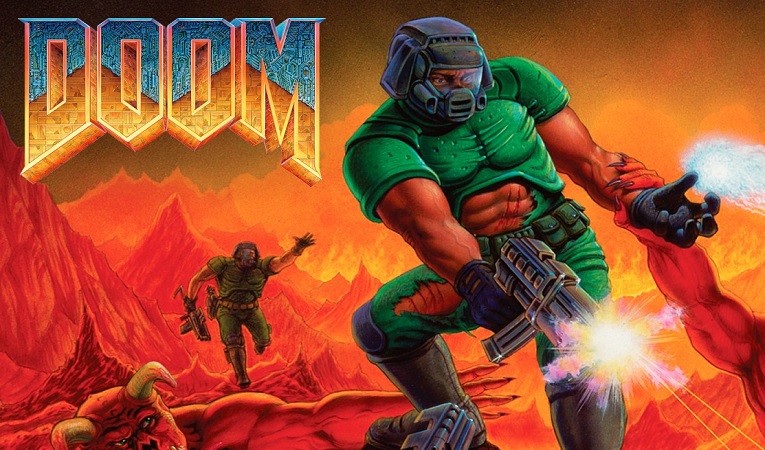
Duake starts with an idea that sounds almost too obvious: put Doomguy into Quake, hand him a Doom-style arsenal and see what happens. The answer is more interesting than a basic character swap. This isn’t Quake with a different face pasted onto the player model. Duake changes weapons, enemy behaviour, encounters, lighting, interface elements and parts of the first episode itself. The original Quake maps are still clearly there, but they don’t play quite the same once Doomguy starts moving through them. That’s the whole appeal.
Doom weapons change Quake’s rhythm
The biggest difference is the arsenal. Quake was built around shotguns, nailguns, explosives and the Thunderbolt. Duake replaces that combat setup with weapons that feel much closer to Doom. There’s a rifle in place of the nailgun, along with other familiar weapon ideas that shift the pace toward faster, more direct shooting. That matters because Quake’s levels were designed around a very different set of tools.
Enemies often attack from ledges, balconies, corridors and open vertical spaces. Quake expects the player to deal with those situations using its own weapon balance. Once Doom-style weapons enter the picture, the same rooms start behaving differently. Encounters can become faster, messier and more aggressive. It still feels like Quake underneath. The movement, architecture and level flow remain familiar. But the combat has a different accent.
Duake also includes two HUD styles. One uses a fuller Doom-inspired layout, while the other takes cues from Doom 64 and keeps things more compact. It’s a small change, but it helps sell the idea that you’re playing something built around Doomguy rather than simply running a weapon mod inside Quake.
Episode one gets most of the attention
The first episode is where Duake does its heaviest work. The maps have been adjusted with coloured lighting, coloured water, extra props and revised enemy placement. Some enemies that normally appear later in Quake can also show up earlier when you play on higher difficulty settings. That keeps the campaign recognisable without leaving every encounter untouched.
New secrets have been added to some maps as well. They don’t turn the levels into completely new creations, but they give returning players another reason to check corners and revisit familiar spaces. Enemy behaviour gets its own set of changes.
Some creatures use modified attacks, the Fiend can appear in a spectre-like form, and Duake adds a new wall demon. The Chthon battle has also been changed instead of being copied over exactly as it was. These adjustments make sense. If you give the player a different arsenal, you can’t always expect the original balance to hold together without some tweaking. Duake tries to account for that.
Movement and smaller mechanics also change
The mod doesn’t stop at guns and enemies. Fall damage was removed in an early update, which immediately changes how freely you can move through Quake’s vertical spaces. Jump buffering was also adjusted so another jump can register if you press the button while still in the air. Those are small details, but you notice them while playing.
Other fixes have touched BFG tracer behaviour, mouse acceleration settings and the Soulsphere pickup sound. None of these features completely redefine the game on their own. Put together, though, they show that Duake is trying to make the crossover work mechanically instead of relying on presentation alone.
The visual changes follow the same approach. Quake’s maps still look like Quake maps. The geometry hasn’t suddenly become Doom. You still get the stone halls, lifts, switches, cramped passages and tall combat spaces that define the original game.
The coloured lighting and water give those environments a different look, while the Doom-inspired weapons and HUD sit directly in front of you. The two games never fully merge. That’s probably the point.
It still needs Quake
Duake runs as a separate program using Xash3D technology, but it still needs the original Quake game data. You’ll need the Quake pak0 and pak1 files for the content to load properly. You don’t need a copy of Doom.
All four original Quake episodes can be played, although the first episode is clearly the main event. That’s where most of the custom level work, lighting changes and encounter adjustments are focused. The later episodes are much closer to their original form.
Support for expansion content and random custom maps also isn’t something to assume. Duake is built around its own version of the Quake campaign rather than trying to act as a universal Doom-style layer for everything ever made for the game.
A simple crossover idea with a lot of changes underneath
Duake is easy to describe but harder to reduce to one gimmick. Yes, it puts Doomguy into Quake. That’s the headline. But the mod also changes the weapons, HUD, enemy behaviour, movement rules, lighting and parts of the first episode. The result sits somewhere between a gameplay conversion and a campaign remix.
Quake is still underneath it all. You’ll recognise the maps immediately. You just won’t play them the same way.
MORE AMIGA & RETRO NEWS
 Doom64-RT gives Doom 64 the graphics upgrade it never had
 Experimental z386 MiSTer build gets id Software’s Quake running
 This ambitious Doom 3 mod rebuilds Doom II from the ground up
 Quake gets huge 30th anniversary update with 19 new maps
 Inside the Neo Geo Doom port: sprites, BSP rendering and developer tricks
 Doom running on Microsoft Fabric shows the power of interactive data apps
 Someone made Doom run on Sega Genesis, and the hardware is probably crying
 Quake at 30: the PC game that quietly rewired gaming culture
 Amiga Quake ports get visual upgrade with improved 32-bit reconstruction
 Chocolate Doom Amiga port gets cleaner 32-Bit scaling for better Doom gameplay
 Doom soundtrack enters the Library of Congress as video game music history
 AmiQuake2RTG update shows Quake II still has life on upgraded classic Amiga systems
 Quake III Arena gets a stunning RTX Remix upgrade with 27 remastered levels
 Sharp X68000 Quake port adds sound and major performance boost
 50 Amazing games you can play on AmigaOS 4 and AmigaOne computers