
Dune II has found its way onto a much wider range of Atari ST hardware. The latest Atari version of OpenDUNE now supports the standard Motorola 68000 processor, opening the game up to ordinary ST and STE systems alongside the faster Mega STE, TT and Falcon. It’s a fairly substantial change. Previous Atari builds concentrated on machines using 68030-class processors. Great if you had a TT, Falcon or upgraded Atari. Less useful if your machine contained the 8MHz 68000 found in millions of standard STs. This release changes the equation.
A standard Atari ST can now run OpenDUNE
Getting OpenDUNE running on a 68000 involved more than selecting another compiler target and hoping for the best. Several parts of the Atari code needed work before slower hardware could run the engine properly.
Misaligned word accesses have been fixed, an important issue on processors with stricter memory requirements. Cut-scene timing has received changes aimed at slower systems too. The build setup has received updates for newer MiNTLib versions, keeping current Atari development tools in play.
Actual game speed varies quite dramatically between machines. A standard ST or STE manages roughly 6 to 15 frames per second, with the exact figure changing according to activity on screen. Move to a Mega STE and performance rises to around 18 to 20fps.
The TT and Falcon are in another category. Both can reach OpenDUNE’s 60fps limit. Mega STE owners get another useful touch. OpenDUNE automatically switches the CPU to 16MHz and activates its cache when the game starts. Exit the game and the previous machine settings return. No menu digging required.
Each Atari gets its own display setup
OpenDUNE doesn’t force every Atari into the same graphics mode. On a standard ST or STE, the game runs in ST Low resolution at 320×200 with 16 colours. A TT uses its 320×480 low-resolution 8-bit display mode. Falcon owners can run at either 320×200 or 320×240 using 8-bit colour, giving the machine access to a 256-colour display.
Input receives Atari-specific treatment too. Keyboard and mouse support use a custom IKBD interrupt routine, keeping controls tied closely to Atari hardware rather than relying on a generic compatibility layer.
Audio varies by machine and setup. Systems with Atari DMA sound can handle digitised effects and speech. Music goes through the Atari MIDI output, with configuration available for General MIDI and MT-32 compatible equipment. So, yes, an ST can run it. A Falcon gets a considerably richer version.
You still need the original Dune II files
OpenDUNE supplies an engine, not a complete copy of Dune II. Players need data files from the DOS release of Dune II version 1.07. Those files go into a DATA directory beside OPENDUNE.TOS, the Atari executable.
Configuration can sit inside an optional OPENDUNE.INI file. Saved games and settings use a separate SAVES directory.
It’s a straightforward setup for anyone with the required DOS game files and an Atari hard-drive configuration. OpenDUNE reads the existing graphics, maps, sounds and other game data, with its own engine handling the Atari side.
Dune II still makes an interesting test for an ST
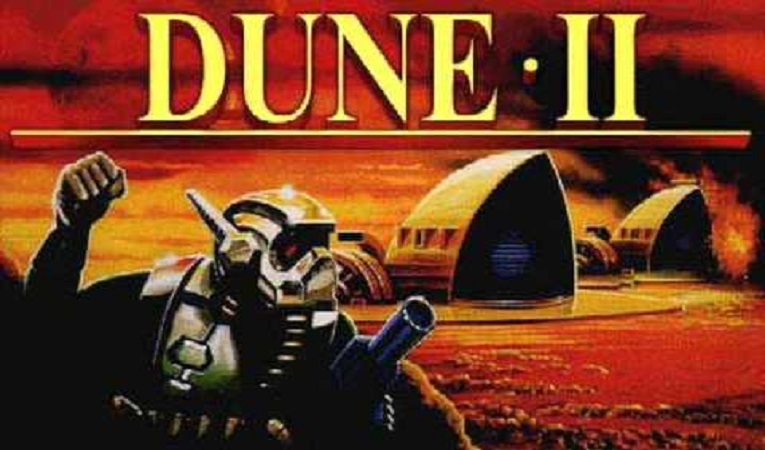
Westwood Studios released Dune II in 1992 through Virgin Games, years before Command & Conquer turned its particular style of real-time strategy into a much bigger commercial force. Dune II wasn’t the first real-time strategy game, yet many ideas associated with the genre came together here in a form players could immediately grasp. Harvest resources. Build a base. Produce units. Improve your available technology. Select troops with a mouse and send them across the map without stopping the simulation between moves.
It proved influential for good reason. Those mechanics place plenty of pressure on early Atari hardware. Units remain active across the map, the interface responds to mouse input, animations keep moving and the simulation continues underneath everything else. On an 8MHz 68000, every part of this workload counts.
One port now covers far more Atari hardware
The interesting part of this OpenDUNE release isn’t a new campaign, graphical overhaul or altered rule set. Its focus sits much closer to the hardware. OpenDUNE can now scale from an ordinary 68000-based Atari ST through the STE and Mega STE, right up to the TT and Falcon.
Slower computers get code changes aimed at making the game practical. Faster machines get higher frame rates, richer display modes and extra hardware features where available. It leaves Atari users with a considerably broader Dune II option than before. And for the humble 8MHz ST, getting the game running at all is probably the headline.
MORE AMIGA & RETRO NEWS
 Atari TOS comes to Sega Mega CD through EmuTOS
 Dune City combines Dune 2 with classic SimCity gameplay
 Duke Nukem on Atari ST: the original DOS shooter finally reaches Atari’s 16-bit computer
 Snow Bros for Atari Falcon: Toaplan’s platform classic returns to Atari’s most advanced computer
 Sega Mega Jet: the Mega Drive built for Japan Airlines
 How Commodore’s lawsuit slowed Jack Tramiel’s Atari computer plans
 Command & Conquer fan port brings Westwood’s RTS classic to Atari ST
 Atari Falcon 030 gets an impressive port of Capcom’s Knights of the Round
 Dune 2000 retrospective: how a legendary RTS remake got buried in the sand
 Atari and Commodore are back: the old rivalry enters a new generation
 Dune 1992 Amiga retrospective: the cult classic that blended strategy, story and spice
 Command & Conquer is coming to Atari STe in ambitious fan port
 Re-Falcon project: bringing the legendary Atari Falcon 030 back to life
 Spice wars return to Amiga with the latest OpenDUNE RTG release
 Atari Falcon explained: Atari’s most ambitious and last computer