
Commander Keen running on a NES sounds like something from an alternate version of the early 1990s. Yet here it is in 2026, running as an actual NES game. Created by Ronald Stoner, Keen NES takes material from id Software’s Commander Keen Galaxy games and rebuilds it for Nintendo’s 8-bit console. It isn’t an emulator, and it isn’t a DOS game hidden inside a modern wrapper. The project creates a proper NES ROM, with the levels, graphics, movement and other game elements adapted for Nintendo hardware. The result is immediately recognisable. There’s Commander Keen, his pogo stick, the colourful stages and the familiar side-scrolling platform action, now appearing on a machine where the original games were never released. It makes for an unusual conversion.
Commander Keen on a very different machine
Commander Keen was created for DOS PCs, not consoles. The series first appeared in 1990 with Invasion of the Vorticons, produced by the team soon to become id Software. At the time, smooth scrolling platform games were closely associated with machines such as the NES. PC games often worked very differently. Commander Keen helped change expectations by bringing faster, console-like scrolling to IBM-compatible computers.
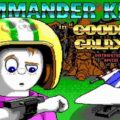
The series moved forward again with the Galaxy games in 1991. Commander Keen 4: Secret of the Oracle and Commander Keen 5: The Armageddon Machine formed the Goodbye, Galaxy release, followed by Commander Keen 6: Aliens Ate My Babysitter.
These games introduced larger stages, more detailed EGA graphics, world maps, new enemies and the pogo-stick movement many players associate with the series. Keen 4 became particularly widespread through shareware. Players could get Secret of the Oracle separately, which gave the game a huge presence on home PCs during the early 1990s.
This isn’t a simple graphics swap
Moving Commander Keen onto the NES involves more than reducing the colours and changing the controls. The original PC games store their stages, characters, music and graphics in formats created for DOS hardware. Keen NES takes those original files and converts the material into forms Nintendo’s console can use.
Much of this work happens automatically during the build process. The project reads the original game data, prepares the graphics and levels, and creates an NES ROM from the converted material.
Underneath, a new game engine handles the Nintendo version. For players, though, the result matters more than the process. The goal is to get something recognisably close to Commander Keen running within the limits of an NES cartridge.
MMC5 gives the project extra room
Keen NES uses the MMC5 mapper, one of the more advanced cartridge chips used with Nintendo’s 8-bit console. NES cartridges could contain extra hardware to help games handle larger amounts of data, more complicated graphics or other features beyond the basic console specification. MMC5 offers several useful options for a project such as this, including extra graphics flexibility and additional audio capabilities.
In practical terms, it gives Keen NES more room to recreate the busier graphics found in the PC games. The NES still has strict limits. Colours work differently, backgrounds are built differently, memory is far tighter and every stage needs to fit within the cartridge structure. So parts of Commander Keen have to be adapted rather than copied directly.
Keen 4 is currently the main attraction
The project covers material from Commander Keen 4, 5 and 6, though development isn’t equally advanced across each game. Keen 4 currently provides the clearest playable example. Its world map is present, along with a limited selection of stages. Some enemies, animations and other parts of the original game remain incomplete.
So this isn’t a finished NES edition of Goodbye, Galaxy. What exists already gives a clear sense of the idea. The distinctive movement survives. Levels retain their familiar structure. The visual style has been translated into something much closer to what an NES cartridge can display. There are compromises, as you’d expect from moving a DOS game onto hardware released years earlier.
A curious meeting of PC and console history
Commander Keen occupies an interesting place in early id Software history. It arrived before Wolfenstein 3D and Doom pushed the studio in a very different direction, during a period when the team was experimenting with ways to make PC games move more like console releases. Keen NES reverses the situation.
A game series once created to bring console-style platforming to DOS is now being rebuilt for the console hardware it once resembled. The project is still in development, but its premise is already clear. Take the original Commander Keen Galaxy data, convert it for Nintendo’s machine, and see how much of the game can survive the move. More than thirty years after Secret of the Oracle appeared on PC, Commander Keen has finally found his way onto an NES cartridge. Just not in the way anyone would have expected in 1991.
MORE AMIGA & RETRO NEWS
 NES Radar brings real time aircraft tracking to Nintendo’s 8-bit console
 The Nintendo NES just got a working CD Drive thanks to this wild mod
 Commander Keen 4 3DO port brings the 1991 PC classic to new hardware
 Commander Keen 1 gets a Sega Master System port after 35 years
 The Samurai NES in India: Nintendo’s forgotten 8-Bit console launch
 Argentina’s Family Game empire: how Famiclones outsold the real NES
 The AARD code story: Microsoft’s quiet attack on DR-DOS compatibility
 Compaq DOS 3.31: the forgotten DOS release that broke the 32 MB barrier
 Why Norton Commander became a legendary MS-DOS file manager
 Bobby Prince, legendary composer of DOOM, Wolfenstein 3D and Duke Nukem 3D, has died
 Batman: Return of the Joker NES port brings the Dark Knight to Sega Master System
 A/NES 1.22 update improves Nintendo emulation on classic AmigaOS
 PPUX: the new open source NES art editor every ROM hacker should try
 How Commander Keen changed the face of MS-DOS gaming forever
 Commander Keen Dreams: Great ’90s MS-DOS nostalgia