
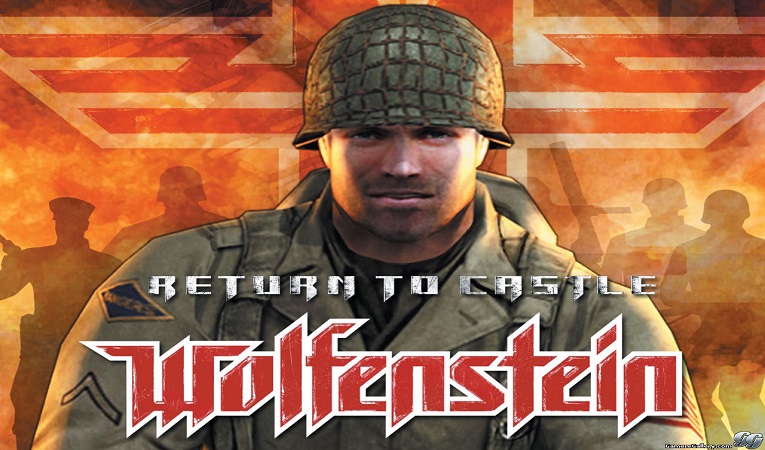
Return to Castle Wolfenstein has found itself on AmigaOS 3.x. Yes, the 2001 shooter. A new version now lets Pistorm equipped Amiga system play through its single-player campaign, complete with missions, cutscenes, weapons, enemies, mouse control and sound. Multiplayer isn’t part of the package, so the focus sits firmly on B.J. Blazkowicz and his increasingly strange mission through castles, military compounds, laboratories and underground ruins. It’s still very much Return to Castle Wolfenstein. The game hasn’t been remade, redesigned or rebuilt into something modern. Its early-2000s character remains intact, from the chunky character models to the rapid gunfights and straight-to-business mission design. And yes, it can move at a decent pace.
B.J. Blazkowicz gets another assignment
Return to Castle Wolfenstein arrived on PC in 2001, years after Wolfenstein 3D helped establish the first-person shooter as a major genre. Rather than copy its predecessor, Return to Castle Wolfenstein went for something larger. B.J. Blazkowicz returns as an Allied agent working behind enemy lines during the Second World War, investigating secret German projects with an increasingly supernatural edge.
The opening escape from Castle Wolfenstein sets the tone quickly. Guards patrol stone corridors. Officers shout orders. Alarms send soldiers running into rooms. Before long, the campaign moves into villages, crypts, military installations and research facilities. Things get stranger from there.
One mission might involve sneaking past guards with a silenced weapon. Another puts B.J. in the middle of a noisy firefight. Soon enough, conventional soldiers share screen space with experimental creatures and occult threats.
Return to Castle Wolfenstein never pretends to be a serious historical war game. It borrows the setting, weapons and uniforms, mixes them with pulp fiction, horror and science fiction, and keeps moving.
It remains a very direct shooter
Modern shooters often spend plenty of time building characters, presenting cinematic sequences or guiding players through heavily controlled set pieces. Return to Castle Wolfenstein comes from a different period. You enter a level. You get an objective. You start moving. There’s usually another corridor, courtyard or room waiting a few seconds away, and it probably contains someone who wants B.J. dead. Combat comes quickly and rarely hangs around for long.
The weapons help. Pistols and rifles give way to automatic guns, heavier equipment and more unusual tools as the campaign progresses. They respond quickly, enemies react clearly, and movement remains fast enough to keep encounters lively.
Levels offer more variety than endless grey bunkers might suggest. Snowy outdoor areas sit beside castles, villages, crypts and industrial interiors. Secret rooms reward players who poke around corners rather than sprinting straight for the next objective. It’s old-school structure without becoming primitive.
The Amiga version sticks to the campaign
This release concentrates on single-player. Menus work, cutscenes play, controls behave as expected, and the main campaign can be played using the original game data from a legitimate PC copy. Performance depends on the Amiga setup in use. On suitable accelerated systems, early sections can reach around 40 frames per second in lighter scenes, with busier movement dropping into the 20s and 30s. For a shooter from this period, those numbers put the campaign comfortably into playable territory.
A few visual details differ from the original PC release. Certain shadow effects and some mirror or portal effects aren’t present. Players who spent a lot of time with the PC version may spot those changes. During ordinary firefights, the bigger impression comes from seeing the complete game operating on AmigaOS 3.x at a usable speed. There’s no multiplayer mode here. Anyone hoping to recreate online matches will have to stick with other versions. For the campaign, though, the main pieces are in place.
Twenty-five years later, it’s still unmistakably Wolfenstein
Return to Castle Wolfenstein turns 25 in 2026, and its age shows in plenty of places. Faces are angular. Rooms use relatively simple geometry. Animation belongs firmly to the early 2000s. Yet its pacing remains easy to appreciate.
Missions don’t spend long explaining themselves. Gunfights arrive often. New locations appear before the previous one has worn out its welcome. The switch from military shooter to supernatural action gives the campaign a personality many later Second World War games deliberately avoided. Now it runs on AmigaOS 3.x too.
For players with the required accelerated Amiga setup and original game files, the proposition is refreshingly uncomplicated. Install it, start the campaign, escape the castle and see how far B.J. gets before the Nazis start sending stranger things after him.
MORE AMIGA & RETRO NEWS
 Wolf64 delivers Wolfenstein 3D on an unexpanded Commodore 64
 Return to Castle Wolfenstein censorship ends in Germany after 24 years
 Amiga and Hyperion agreement: full breakdown of AmigaOS rights
 Bobby Prince, legendary composer of DOOM, Wolfenstein 3D and Duke Nukem 3D, has died
 Gears of War returns on PC with the ambitious Gears of War Redux overhaul mod
 Timothy De Groote after 17 months as Hyperion Entertainment director: what has changed?
 Brutal Wolfenstein-Part II demo release gives Doom II a brutal Wolfenstein makeover
 Forgotten Return to Castle Wolfenstein campaign Cursed Sands arrives on PC
 Isowulf turns Wolfenstein 3D into an isometric shooter — and it actually works
 Wolfenstein 3D at 34: how Id Software’s MS-DOS shooter changed gaming forever
 50 Amazing games you can play on AmigaOS 4 and AmigaOne computers
 50 Classic Commodore 64 games that made the C64 the king of 80s gaming
 The 50 best Amiga games of all time: a nostalgic journey through the Commodore era
 From pixels to Prime: Amazon adapting Wolfenstein for TV
 Return to castle Wolfenstein available for AmigaOS 4.1