
Commander Keen 1: Marooned on Mars has a new Amiga port, and this one takes a different route from earlier versions. Rather than aiming at the stock graphics hardware found in classic machines, the release uses RTG and targets upgraded Amiga systems with suitable graphics hardware. It isn’t the first Amiga conversion of the 1990 DOS platformer. An earlier port already exists. This release comes from a different technical angle, aimed at people running more heavily upgraded Amiga setups rather than a basic machine from the early 1990s. So, yes, it’s Commander Keen on Amiga again. The interesting part is how it gets there.
Commander Keen takes the RTG route
RTG, or retargetable graphics, gives Amiga software a way to display graphics through supported graphics cards instead of relying directly on OCS, ECS or AGA. For this port, RTG sits at the centre of the graphics side. It makes the release a natural match for accelerated Amigas fitted with later graphics hardware, extra memory and faster processors.
Don’t expect a conversion built around the restrictions of a standard Amiga 500. This isn’t trying to squeeze the DOS original into an early stock configuration. It takes the original game and brings it across with upgraded Amiga hardware in mind. From a player’s perspective, the game itself remains familiar. The DOS release provides the visual and mechanical blueprint, with the Amiga handling display duties through RTG.
Before Doom, there was Commander Keen
Commander Keen 1 arrived on MS-DOS in December 1990 under its full name, Commander Keen in Invasion of the Vorticons: Marooned on Mars. It came from the team soon to become id Software, with Apogee Software handling publication. This was years before Doom turned id into one of PC gaming’s biggest names.
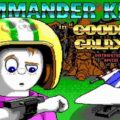
Marooned on Mars introduced Billy Blaze, an eight-year-old inventor who adopts the Commander Keen identity, puts on a football helmet and heads to Mars aboard a spacecraft built at home. His trip goes wrong after aliens steal parts from his ship, leaving him stranded until he recovers each missing component. It’s a simple setup, which suits the game.
Players move around a map, enter individual stages, collect items, avoid hazards and deal with enemies. A raygun gives Billy a means of clearing certain threats, but the pogo stick became one of the series’ signature ideas.
Pick it up and jumps become much higher. Levels use this mechanic for platforms, routes and collectibles sitting beyond a normal jump. It gives movement a rhythm of its own and makes exploration more involved than running from left to right.
A PC platformer doing unusual things in 1990
Part of Commander Keen’s reputation comes from its technology. Smooth horizontal scrolling wasn’t something DOS PCs handled particularly well in 1990. Consoles and home computers often had hardware better suited to scrolling graphics, leaving PC action games with a different set of technical problems.
The team behind Commander Keen developed a scrolling method capable of producing far smoother movement on EGA hardware. Marooned on Mars became an early demonstration of what a DOS platform game could do with clever graphics programming.
Its presentation is unmistakably early PC. Sixteen-colour EGA graphics, chunky sprites, compact levels and a straightforward interface define its appearance. None of this new Amiga work tries to rebuild the game into something visually unrelated. It remains Marooned on Mars.
RTG gives the Amiga version a different target
Traditional Amiga games often communicate closely with Commodore’s custom graphics chips. ECS and AGA each came with their own capabilities, restrictions and programming techniques. RTG takes another approach. Software can send graphics through a common system used by compatible graphics cards, rather than tying display code directly to one Commodore chipset. For an Amiga port of a DOS game, this changes the hardware target considerably.
An RTG machine is likely to be an upgraded system rather than a stock early model. Many such setups pair accelerator boards with extra RAM and graphics cards, creating an Amiga configuration far removed from an original A500 sitting under a television. This port belongs in this category.
A second way to play it on Amiga
Since Commander Keen 1 has appeared on Amiga before, the new release isn’t replacing some missing conversion from the machine’s catalogue. It offers another implementation with a separate hardware focus. RTG is the defining difference.
The game underneath remains the 1990 platformer built around Mars, stolen spacecraft components, map exploration, rayguns and pogo-assisted jumping. Its structure hasn’t been reinvented for this release, nor does it need to be. What has changed is the Amiga sitting underneath it.
Instead of aiming at Commodore’s original graphics chipsets, the new port uses an RTG display environment suited to upgraded machines. For anyone running such a setup, it provides another route into one of id Software’s earliest PC games, this time through an Amiga graphics configuration built long after the original DOS release arrived.
MORE AMIGA & RETRO NEWS
 Commander Keen 4 returns with a new AmigaOS 68k edition
 Two legendary Wing Commander games just got a serious modern PC refresh
 What if Commodore had abandoned everything except Amiga?
 Commander Keen NES turns id Software’s PC classic into a Nintendo game
 Commander Keen 4 3DO port brings the 1991 PC classic to new hardware
 Commander Keen 1 gets a Sega Master System port after 35 years
 The AARD code story: Microsoft’s quiet attack on DR-DOS compatibility
 Compaq DOS 3.31: the forgotten DOS release that broke the 32 MB barrier
 Why Norton Commander became a legendary MS-DOS file manager
 P96 3.6.3 Released: major Amiga RTG graphics update adds new drivers and fixes
 Amiga Quake ports get visual upgrade with improved 32-bit reconstruction
 Bobby Prince, legendary composer of DOOM, Wolfenstein 3D and Duke Nukem 3D, has died
 Windows 3.0 vs MacOS, AmigaOS and TOS: the 1990 desktop battle that changed computing
 How Commander Keen changed the face of MS-DOS gaming forever
 Commander Keen Dreams: Great ’90s MS-DOS nostalgia