
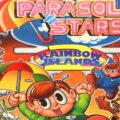
Parasol Stars has made its way to the Sega Mega Drive and Genesis through an unofficial conversion with an unusual technical approach. Rather than recreate Taito’s platform game from scratch, the project uses code from Ocean Software’s Amiga release and adapts it for Sega’s 16-bit console. The complete game is here, including two-player mode and the hidden world. It’s still in beta, with recent work focused on getting it running more reliably on original hardware.
A Bubble Bobble sequel Sega never received
Parasol Stars first appeared on the PC Engine in 1991, following Bubble Bobble and Rainbow Islands. It’s the third game in the series, yet it takes a different approach from its predecessors. Taito made it for a home console rather than an arcade cabinet, and an official Mega Drive edition never followed.
Ocean Software brought Parasol Stars to home computers, including the Amiga and Atari ST, with further versions appearing on NES and Game Boy. The 1992 Amiga release forms this conversion’s foundation.
Bubby and Bobby are still the stars. Their parasols aren’t simply shields: they catch enemies, send them flying across the screen and collect droplets for extra attacks. Most stages fit on a single screen, so success comes from managing enemy movement and deciding where to throw each captured opponent. There are bonuses, bosses and local two-player action.
It’s an Amiga conversion, not a new remake
The technical approach separates this release from a typical fan-made port. The Amiga and Mega Drive share processors from Motorola’s 68000 family, opening the door to reusing much of the original game code. Sega’s console still needs its own methods for displaying graphics, playing audio and reading game data, so the conversion replaces the routines tied to Amiga hardware.
The goal isn’t to modernise Parasol Stars. It’s to reproduce the Amiga game’s behaviour on a different machine. The developer checked gameplay against the computer version frame by frame. It runs at a target of 25 game updates per second, preserving the timing of movement and enemy behaviour. The full set of worlds and bosses is included, along with the hidden world, final sequence and credits.
The sound follows the computer version too
The audio takes a comparable route. Instead of arranging the tunes for the Mega Drive’s FM sound hardware, the conversion reproduces the Amiga music and sound effects through a new playback system. Filtering is replicated, with output streamed at 15.7 kHz.
On a standard three-button pad, A or C makes your character jump and B operates the parasol. Plug in another controller and a second player can join. The options menu lets players select a starting world or round, with infinite lives and invincibility available. The main game remains structured around its original stages and encounters.
Beta 2 tackles real-console problems
The second beta addresses faults discovered during hardware testing. One fix deals with video access responsible for a black screen after leaving the options menu on a physical Mega Drive or Genesis. Changes to transfers between the Z80 sound processor and video memory aim to improve stability, and another correction addresses memory writes capable of interfering with flash cartridges.
There are now two ROM builds. The 8 MB edition needs an SSF2 bank mapper. The alternative 4 MB edition doesn’t need one, offering broader flash-cartridge compatibility. It achieves the smaller size through 4-bit DPCM audio compression and uses a substitute music track in one hidden-world section.
Emulation has a caveat, too. The bank-mapped 8 MB edition can produce incorrect audio in MAME, so Genesis Plus GX is the recommended emulator. PAL users may notice music playing roughly one per cent slower than under NTSC settings.
The full game, with beta warnings
It’s still a beta. Hardware testing continues, and bugs remain possible. Still, the current build offers the complete campaign and two-player play, not a collection of isolated levels.
A game absent from the original Mega Drive library now runs on Sega hardware, using the Amiga edition’s code, timing and audio as its foundation. The focus now is stability across consoles, cartridges and emulators.
MORE AMIGA & RETRO NEWS
 Mega Splatterhouse fan port could get an official Sega Mega Drive release
 Original Shinobi arcade game gets a new Sega Mega Drive conversion
 Mega Pang returns with a new beta release for Sega Mega Drive
 Sonic the Hedgehog 1 and 2 return on new Sega Genesis cartridges in 2026
 Sega tried to launch VR in the 1990s. It went exactly how you think
 OpenTTD 16.0 beta shows why the transport management classic still matters
 Sega Mega Jet: the Mega Drive built for Japan Airlines
 Inside Virtua Racing: Sega’s SVP chip and the Mega Drive’s most ambitious cartridge
 Sonic the Hedgehog at 35: the making of SEGA’s most important game
 Kazutoshi Miyake at Sega Europe: the executive who kept Sega fighting in Europe
 Why the Sega Dreamcast failed: production costs, Sony PlayStation 2, and Sega’s financial losses
 Mega Pang for Sega Mega Drive: a new homebrew tribute to Super Pang
 Contra: Hard Corps retrospective — Konami’s wildest 16-bit action game
 Comix Zone retrospective: Sega’s comic book beat-’em-up that was ahead of its time
 Classic Taito platformer Parasol Stars heading to modern consoles this year