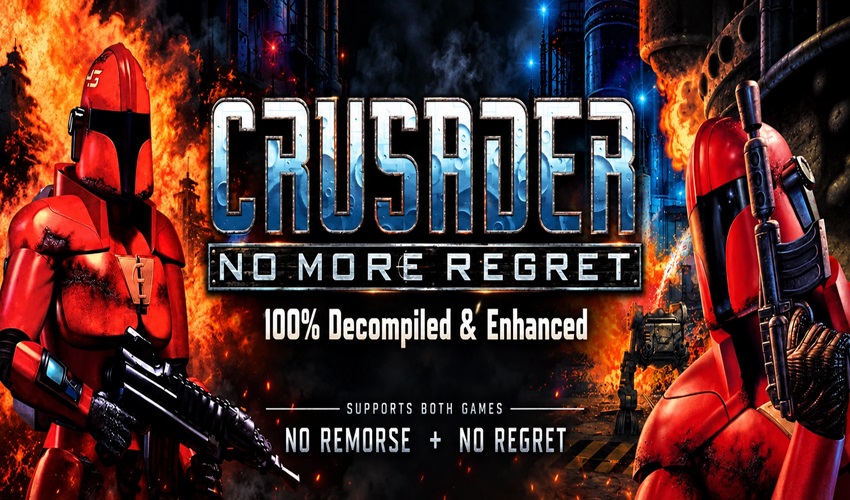
Some games ask you to clear a room. Crusader asks you to wreck it. Guards open fire, barrels explode, alarms start screaming, and an ordinary corridor turns into a battlefield within seconds. It’s the sort of chaotic action PC gamers encountered in the mid-1990s, when Origin Systems gave players two isometric shooters packed with destruction, heavily armed enemies and surprisingly elaborate environments. Now, thanks to No More Regret, both Crusader: No Remorse and Crusader: No Regret have a more convenient home on modern computers. The project brings both games together in a single application, complete with updated controls, improved display options and fixes for problems left over from the original DOS releases. It’s not a remake, and it doesn’t try to turn Crusader into a modern action game. The missions, weapons and distinctive presentation remain familiar. Playing them simply requires less effort.
The Silencer returns to action
Crusader: No Remorse arrived during a particularly interesting period for PC action games. Developed by Origin Systems and published by Electronic Arts, it swapped the usual first-person perspective for an angled overhead view, placing players in control of a heavily armed soldier called the Silencer.
The setting was suitably grim. A powerful organisation called the World Economic Consortium ruled society through surveillance, military force and ruthless corporate control. After turning against his employers, the Silencer joined the Resistance and began attacking the organisation from within.
What followed was a series of missions through industrial complexes, military installations and research facilities. Players could shoot their way through enemy patrols, disable security equipment, operate machinery and use the environment against anyone unfortunate enough to be standing nearby. And there was plenty to destroy.
Explosive barrels, computer terminals and assorted machinery regularly turned firefights into spectacular disasters. The Silencer could roll, crouch and dodge incoming fire, giving combat a physical quality rarely seen in similar games of the period.
The sequel, Crusader: No Regret, continued the story on a lunar installation, introducing new missions, enemies and weapons. Both games featured live-action video sequences, a popular storytelling technique during the CD-ROM era, with actors portraying characters between missions.
Old-school action without the DOS headaches
Getting older PC games running on current hardware can involve a surprising amount of fiddling. No More Regret tackles this problem by bringing the two Crusader titles into one modern application.
Rather than running the original DOS programs, the project uses reworked game code to reproduce their behaviour on contemporary systems. Doors, lifts, weapons, enemies and mission events operate much as players would expect, with fixes addressing various problems inherited from the originals.
Some corrections deal with sound and video playback. Others address save files, unpredictable gameplay behaviour and occasional interruptions during missions. There’s good news for anyone with an existing campaign, too. Original save files remain compatible, so players don’t need to restart their progress.
Better controls for players
Crusader’s controls were always a little unusual, particularly for anyone accustomed to modern PC action games. No More Regret introduces a more familiar keyboard setup, including WASD movement, adjustable key bindings and mouse controls. Gamepads receive support too, offering another way to move the Silencer through corridors packed with armed guards and security equipment.
Display settings have received attention. Players can choose windowed or full-screen operation, retain the original 4:3 aspect ratio or experiment with widescreen presentation. Sound and subtitle options are accessible through the game itself.
There’s a game-speed setting as well. Older DOS software sometimes behaved differently depending on computer performance, affecting movement and certain gameplay interactions. Adjustable speeds offer greater control over the action.
What players need to get started
No More Regret doesn’t include the original Crusader games. Players still need their own copies of No Remorse or No Regret, with support aimed at editions available through GOG and Steam. Windows and Linux users can obtain ready-made downloads. The software has been tested on Apple Silicon Macs, but a packaged macOS download isn’t currently available. Windows builds have received testing under Wine.
A few issues remain, including occasional problems with mouse-controlled weapons and character movement. Further fixes are planned. For anyone curious about Crusader, or interested in playing these unusual PC shooters again, No More Regret removes much of the inconvenience surrounding their original DOS versions. The gunfights are still hectic, the environments remain dangerously explosive, and the Silencer still has plenty of enemies standing between him and his next objective.
MORE AMIGA & RETRO NEWS
 Wing Commander: The Secret Missions finally arrives on Amiga after 30 years
 You haven’t truly played GTA until you’ve finished these 7 missions
 The AARD code story: Microsoft’s quiet attack on DR-DOS compatibility
 Compaq DOS 3.31: the forgotten DOS release that broke the 32 MB barrier
 Why Norton Commander became a legendary MS-DOS file manager
 Dangerous Dave returns: classic DOS platformer gets Sega Master System version
 Monster Bash retrospective: how Apogee turned pet rescue into MSDOS horror fun
 Blackthorne retrospective: why Blizzard’s 1994 DOS platformer still matters
 Wolfenstein 3D at 34: how Id Software’s MS-DOS shooter changed gaming forever
 SDL3 DOS port brings modern cross-platform development to classic MS-DOS
 50 Amazing games you can play on AmigaOS 4 and AmigaOne computers
 50 Classic Commodore 64 games that made the C64 the king of 80s gaming
 The 50 best Amiga games of all time: a nostalgic journey through the Commodore era
 How to get the most authentic DOS gaming experience today
 Strange anti-piracy tricks in video games that made cheaters regret it