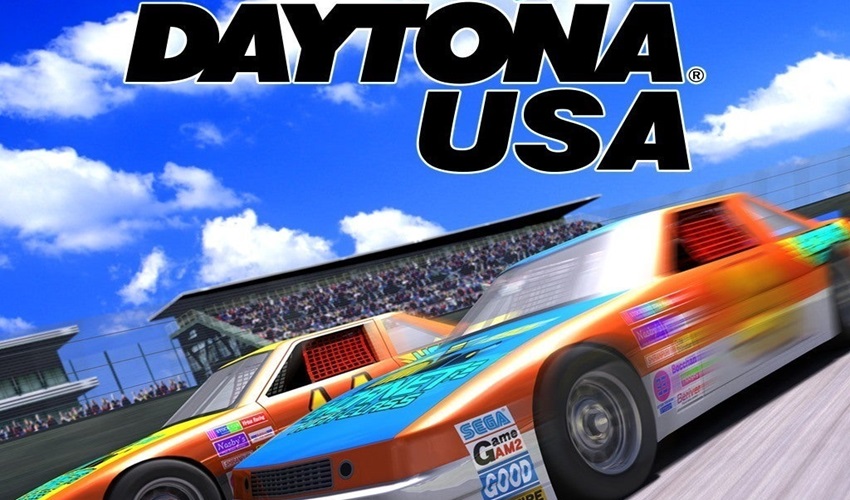
Of the many arcade racing games Sega produced during the 1990s, Daytona USA remains a personal favourite. There’s something irresistible about its brightly coloured stock cars, ridiculously catchy soundtrack and the sheer chaos of squeezing through a pack of 40 competitors. So the arrival of Daytona USA Reborn, an unofficial native PC port of the original arcade game with experimental ray tracing, certainly caught my attention. The project introduces sunlight shadows, improved environmental lighting, widescreen support, smoother animations and several other graphical additions. And yes, you can still race around Three Seven Speedway with Takenobu Mitsuyoshi singing his heart out.
Daytona USA with ray tracing? Absolutely
Ray tracing isn’t something I’d normally associate with a Sega arcade game from 1994, which makes its inclusion here particularly interesting. Daytona USA Reborn uses DirectX Raytracing 1.1 (DXR) to introduce sunlight shadows across the cars and circuits. Vehicles cast more natural shadows onto the asphalt, environmental lighting adds depth to the scenery, and optional light rays bring an extra dimension to the game’s skies.
What I particularly like about this approach is how little it changes the original artistic direction. The cars retain their angular polygonal bodies, the textures remain familiar, and Sega’s colourful interpretation of American stock car racing is instantly recognisable.
There’s no attempt to make Daytona USA resemble Forza Motorsport. Nor does it need one. Ray tracing remains experimental and requires compatible graphics hardware. Players can switch it off and enjoy the game with conventional rendering instead.
Daytona USA in glorious ultrawide
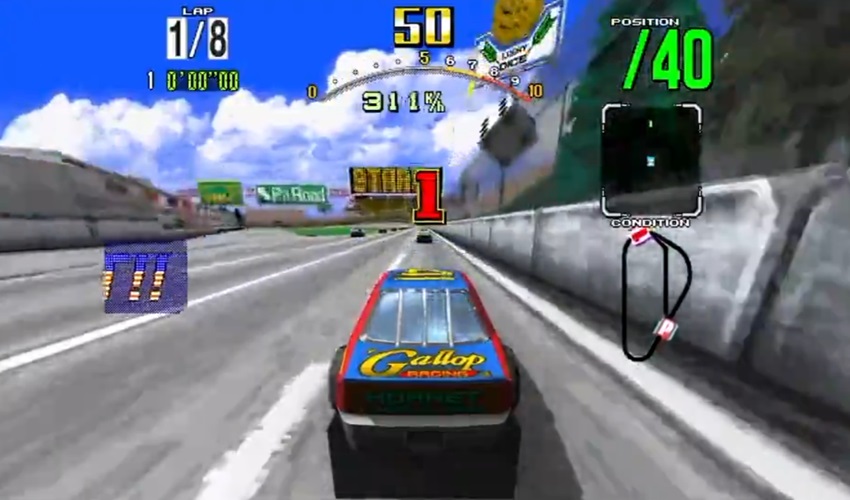
Perhaps more interesting from a practical perspective is the introduction of modern widescreen support. Daytona USA Reborn accommodates 16:9, 16:10 and 21:9 aspect ratios, making it particularly appealing to anyone with an ultrawide gaming monitor.
The wider presentation reveals more of the circuits and surrounding cars without stretching the original 4:3 image. Considering how crowded Daytona’s races can get, the extra screen space makes perfect sense.
I’d be particularly interested in racing through Dinosaur Canyon with an ultrawide display. Its sweeping corners, tunnels and changes in elevation make it one of the most visually interesting circuits in the original game.
The port includes experimental rendering interpolation for smoother movement at 120fps, extra environmental objects, adjustable draw distances and improvements to the rendering of the sky. Those who prefer the original arcade screen proportions can retain the 4:3 format.
Rolling start!
I can’t discuss Daytona USA without mentioning its soundtrack. Few racing games have such an instantly recognisable musical identity, and Takenobu Mitsuyoshi’s enthusiastic vocals are a huge part of its personality. Daytona USA Reborn lets players choose between the original arcade soundtrack, the arrangements from the Sega Saturn and Windows versions, and the music featured in the Dreamcast edition.
Personally, I’d have a difficult time choosing anything other than the original arcade soundtrack. Let’s Go Away, The King of Speed and Sky High are practically inseparable from their respective circuits, but having the option to experiment with different arrangements is a welcome addition. The alternative soundtracks require separate audio files, which players must supply themselves.
When Sega ruled the arcades
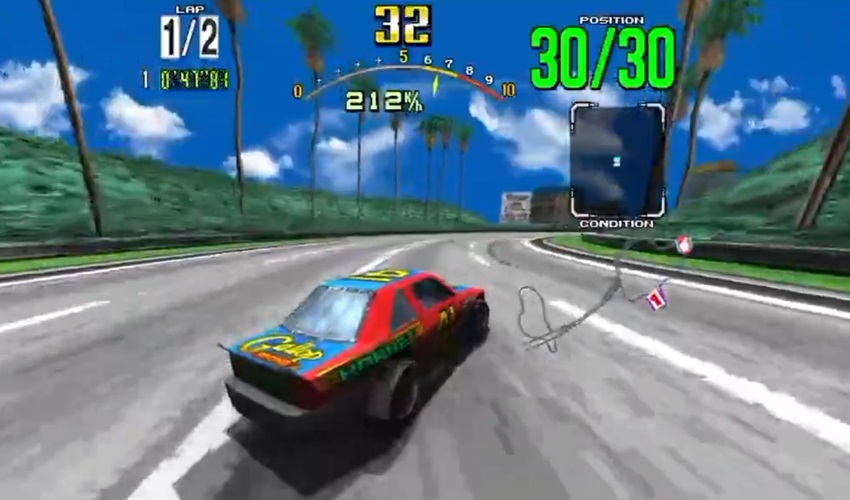
Developed by Sega AM2 and released in arcades in 1994, Daytona USA represented a significant technical achievement for its time. Sega’s Model 2 hardware delivered textured 3D environments at 60fps, with large numbers of competing vehicles and an impressive sense of speed.
Yet its appeal went far beyond the graphics. Daytona USA understood something many racing games struggle with: driving a car should be entertaining from the moment you grab the steering wheel.
Its three circuits, Three Seven Speedway, Dinosaur Canyon and Seaside Street Galaxy, offered progressively more demanding racing. Learning how to slide through corners without sacrificing too much speed was part of the fun, particularly on the advanced and expert courses.
The Sega Saturn received its conversion in 1995, followed by a Windows release in 1996 and a substantially revised Dreamcast edition in 2001. Sega eventually brought the arcade experience to PlayStation 3 and Xbox 360 in 2011.
A new native PC version for Windows
Daytona USA Reborn doesn’t rely on traditional arcade emulation. Instead, the project uses static recompilation to translate the original arcade program into native PC code, creating room for graphical features beyond the capabilities of Sega’s Model 2 hardware.
The port supports 64-bit Windows 10 and Windows 11, requires a compatible arcade ROM set and involves an initial compilation process. The developers don’t include the original game data. It’s still a beta, and several features remain experimental. I’m particularly curious to see how the ray-traced lighting and 120fps rendering develop.
For a racing game with only three circuits and more than three decades behind it, Daytona USA still has an astonishing amount of personality. The prospect of tackling Seaside Street Galaxy with ultrawide support, smoother animation and modern lighting is certainly an appealing one.
MORE AMIGA & RETRO NEWS
 Fighters Megamix returns with sharper graphics, ultrawide support and rollback netcode
 Need for Speed: Underground 2 returns with 4K graphics and ray tracing thanks to Overbright
 Sega Rally 2 Native brings the original Model 3 arcade game to Windows
 Daytona USA’s original arcade version is now running on Sega Dreamcast
 Daytona USA is now playable on PSP thanks to an unofficial arcade port
 Daytona USA fan port brings Sega’s arcade racer to Windows, Mac and Linux
 Sega 32X gets an unofficial Daytona USA port powered by Virtua Racing Deluxe
 Doom 3 gets Vulkan, ray tracing and modern graphics with DUDE
 Cruis’n USA comes to life on the Atari Jaguar in impressive 3D tech demo
 Virtua Racing arrives on PC & Xbox with 4K and eight-player support
 Inside Virtua Racing: Sega’s SVP chip and the Mega Drive’s most ambitious cartridge
 Qwak Reborn revives the fast, frantic spirit of Amiga platform gaming
 Need for Speed III: Hot Pursuit retrospective: why the PlayStation classic still matters
 4PGP is the ’90s arcade racing comeback PS5 and PC players need
 Why the Commodore Amiga was important for early 3D rendering and ray tracing