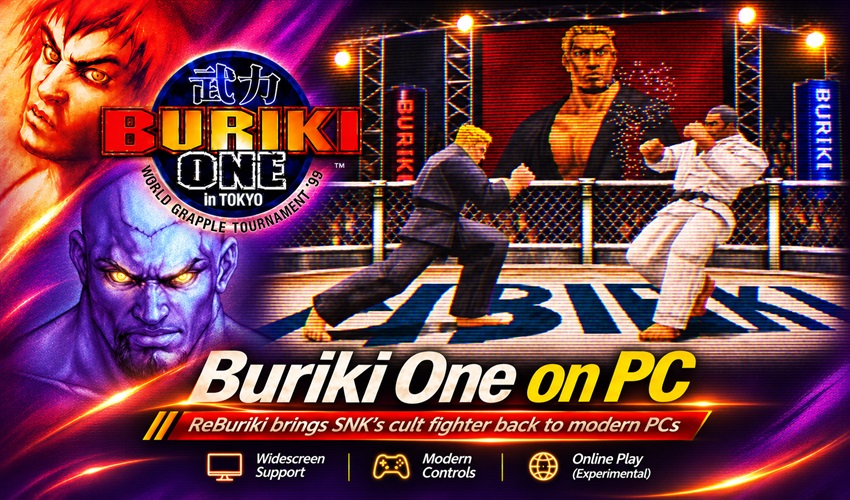
There’s something special about discovering an SNK fighting game which refuses to play by the usual rules. Buriki One is exactly such a game. No spectacular fireballs, no frantic button combinations, and certainly no familiar fighting game controls. Instead, it’s a wonderfully strange martial arts fighter with its own ideas about how combat should work. And now, thanks to ReBuriki, this unusual arcade title has found its way onto Windows, complete with widescreen graphics, customisable controls and online multiplayer. For anyone with a soft spot for SNK’s more adventurous games, it’s an exciting development.
SNK’s most unusual fighting game
Buriki One arrived during SNK’s ambitious move into 3D arcade gaming, running on the Hyper Neo Geo 64 hardware. It was a very different proposition from The King of Fighters or Fatal Fury. Rather than filling the screen with special attacks and elaborate combinations, Buriki One focused on recognisable martial arts and carefully timed encounters. And what a fascinating collection of fighters it offered.
The roster brings together practitioners of karate, boxing, judo, sumo, wrestling, Muay Thai and taekwondo. Gai Tendo takes centre stage, joined by familiar SNK character Ryo Sakazaki from Art of Fighting. There are eleven competitors to choose from initially, with the mysterious Silber bringing the number to twelve. It’s a fighting game with a surprisingly grounded identity. Every discipline has its own character, and the differences become apparent once a match begins.
Forget everything about normal fighting controls
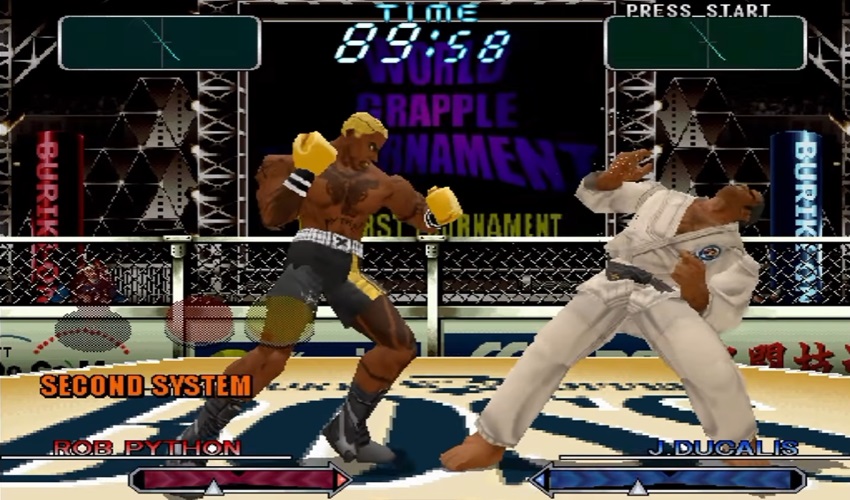
Here’s where Buriki One becomes genuinely interesting. SNK decided to turn the traditional fighting game control scheme upside down. Instead of moving with the joystick and attacking with buttons, players use two buttons to step left or right. The joystick controls punches, kicks, throws and other techniques. It sounds completely wrong on paper. Spend some time with the idea, though, and you can see why Buriki One stands apart.
Combat becomes a question of spacing, timing and choosing your moment. There’s less emphasis on performing spectacular combinations and more attention paid to individual exchanges. The fighters use 3D character models, but movement remains largely restricted to a side-on plane. It’s certainly different. And for me, this willingness to experiment is precisely what makes Buriki One so interesting.
ReBuriki gives the fighting a fresh presentation
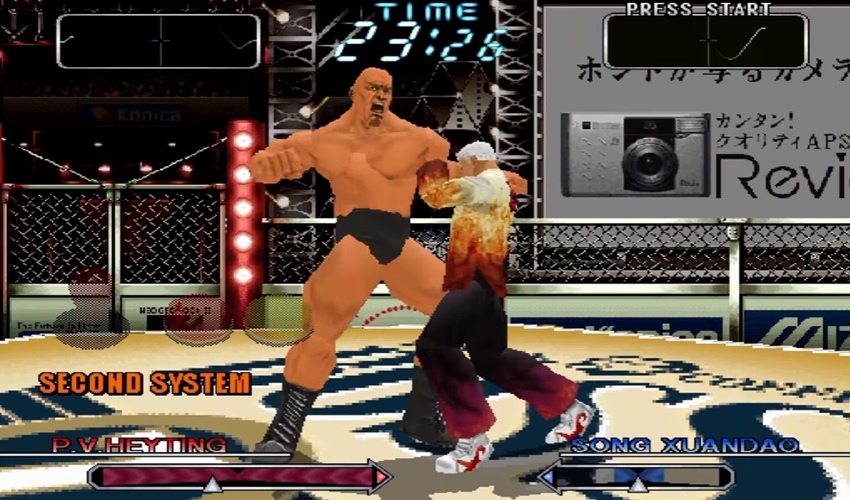
One of the first things you’ll notice about ReBuriki is the improved image quality. The PC port can render the game’s 3D graphics at much higher resolutions, giving characters and arenas cleaner outlines on modern displays.
The difference becomes particularly apparent during combat, where the original low-resolution presentation gives way to a much sharper picture. Widescreen support is another welcome addition. Matches can fill 16:9 and ultrawide 21:9 monitors, revealing more of the arena. Character selection and other menu screens retain their original 4:3 proportions.
Players can switch between the original visual presentation and the upgraded rendering, with further settings for filters, screen modes and health-bar positioning. It’s a practical update, and one which gives the fighting room to breathe.
Modern controls make a big difference
Of course, an unusual arcade control scheme doesn’t automatically translate neatly to a modern controller. ReBuriki addresses this with several input configurations. The default Xbox-style setup places movement on the left stick and attacks on the right. Alternative arrangements recreate the arcade controls or assign techniques to conventional controller buttons. Keyboard support and fully customisable mappings are included.
There’s plenty of the original arcade experience here too. Local two-player matches, difficulty settings, match timers, saved records and operator options are present. Players can select English or Japanese settings, activate free play and make Silber available from the beginning. For anyone eager to explore the mechanics rather than wrestle with unfamiliar controls, these options are particularly welcome.
Online matches are an exciting addition
ReBuriki doesn’t stop at local multiplayer. Two players can fight over the internet through a direct connection, with rollback networking helping to keep matches responsive. There is a catch. Online functionality remains experimental, and there’s no automatic matchmaking or lobby system.
Internet connections can require manual configuration, making local multiplayer the easier choice for now. Still, seeing online functionality included in such an unusual arcade fighting game is genuinely encouraging.
A few things to remember before playing
ReBuriki runs on 64-bit Windows 10 and Windows 11. Higher-resolution graphics require a Direct3D 11-compatible graphics card, with the original display mode offering a less demanding option. Players must provide legally obtained Buriki One and Hyper Neo Geo 64 system ROMs during installation. The download doesn’t contain the original game, and this isn’t an official SNK release.
What makes ReBuriki exciting isn’t simply the prospect of playing another old arcade fighter on PC. It’s the opportunity to spend time with a game which approached its genre from an entirely different direction. Buriki One never followed the established SNK formula, and its strange controls remain its most fascinating feature. I’ve always appreciated fighting games willing to take such risks. ReBuriki gives this one another chance to surprise us.
MORE AMIGA & RETRO NEWS
 Sega’s Fighting Vipers 2 makes a return on PC with a few welcome changes
 Neo Geo Battle Coliseum could soon be playable natively on Windows
 Samurai Shodown: Warriors Rage recomp brings the PS1 fighter to Windows
 Art of Fighting 3 R could be the SNK remaster retro fighting fans were waiting for
 UniBIOS: the Neo Geo upgrade that unlocked AES and MVS hardware
 Sega’s last console had a hidden connection to SNK’s Pocket fighter
 Ninja Master’s preview: SNK’s 1996 Neo Geo fighting game heads to Steam
 Virtua Fighter Crossroads: the comeback that could reshape fighting games
 Bunraku hands-on preview: ninja combat, party chaos and online PvP
 SNK opens Neo Geo Styles store with Fatal Fury and Metal Slug merch
 SNK just gave Katsuhiro Harada his own development studio
 World Heroes Perfect Steam release revives a cult Neo Geo fighting game
 50 Amazing games you can play on AmigaOS 4 and AmigaOne computers
 50 Classic Commodore 64 games that made the C64 the king of 80s gaming
 The 50 best Amiga games of all time: a nostalgic journey through the Commodore era