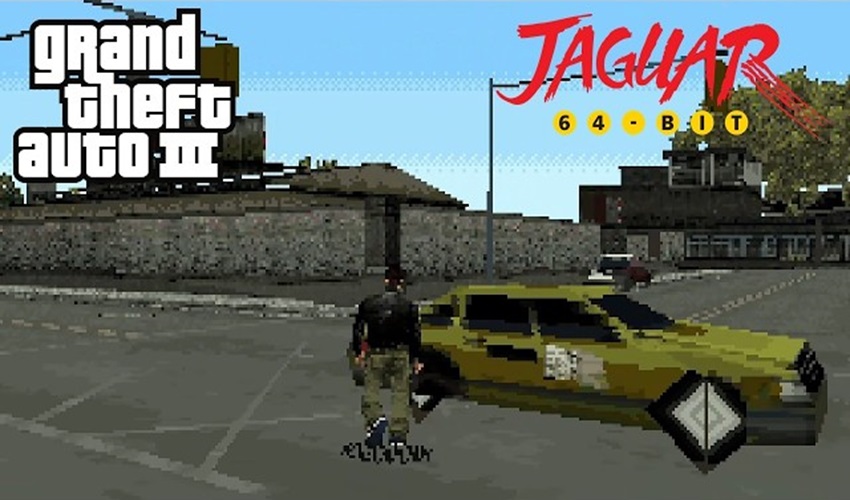
Of the many games I’d love to see running on an Atari Jaguar, Grand Theft Auto III probably wouldn’t have crossed my mind. Rockstar’s 2001 open-world adventure seemed a generation beyond anything Atari’s 64-bit console could reasonably handle. Yet developer Budfolk has managed to bring Liberty City to original Jaguar hardware, complete with moving traffic, textured buildings, animated pedestrians and familiar sound effects. You can even steal cars. As someone with a soft spot for experimental console ports, it’s the amount of functioning gameplay here I find particularly fascinating. Budfolk hasn’t simply recreated a few streets or rendered some buildings. There’s a working game underneath, with five districts of Liberty City available to explore.
Liberty City running on original Atari Jaguar hardware
One of my favourite aspects of this project is the hardware itself. Budfolk runs the demonstration on an original Atari Jaguar connected to a CRT television, using a Skunkboard development cartridge. There’s no supplementary processor inside the cartridge handling the more demanding calculations, and the console doesn’t rely on emulation.
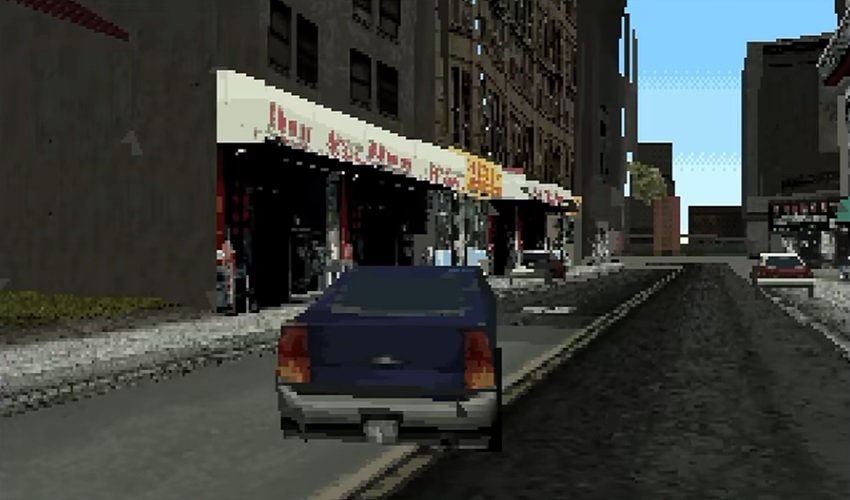
The developer uses geographical data, textures and character animations extracted from the original GTA III. The buildings have their familiar shapes, vehicles travel through the streets and pedestrians wander along the pavements.
It’s strange seeing such recognisable PlayStation 2 environments running on a console released in 1993. The Jaguar predates Rockstar’s game by eight years and has only 2 MB of RAM available for its various operations.
Getting the most out of Atari’s unusual architecture
I’ve always found the Jaguar’s hardware particularly interesting, partly for its unconventional approach to processing. Budfolk’s implementation makes extensive use of its five processing units, assigning different responsibilities to each component.
The Motorola 68000 manages vehicle movement, traffic and pedestrian behaviour. The graphics processor handles polygon calculations and rendering, with the Jerry chipset’s digital signal processor calculating which sections of Liberty City need to appear in the following frame.
The blitter reads textures directly from the cartridge rather than occupying valuable system memory. The Object Processor combines the rendered streets with the sky, minimap and other graphical interface elements.
Budfolk has previously experimented with Super Mario 64 and Duke Nukem 3D on the Jaguar. Some of the techniques developed during those projects now form part of the GTA III rendering engine.
There’s a surprising amount of GTA III here
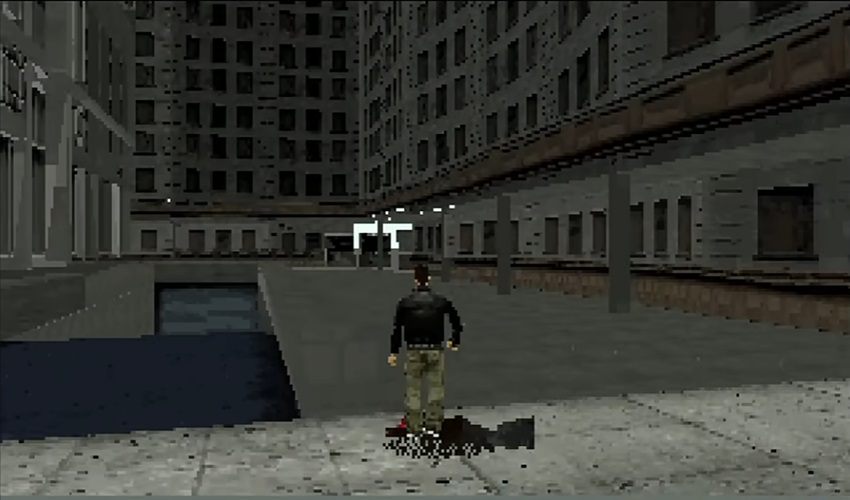
What caught my attention most wasn’t necessarily the textured buildings. It was the pedestrians. They walk around using animations from Rockstar’s original game, react to physical encounters, fall over and get up again. Cars travel through the streets, engine sounds accompany the driving sequences, and pedestrian voices give the surrounding environment some familiar GTA III character.
The game operates in a 256-colour display mode, using 48 principal colours across four lighting intensities. Visually, it’s considerably different from the PlayStation 2 release, but there’s no mistaking those Liberty City streets.
Performance currently fluctuates between 11 and 15 frames per second. It’s hardly smooth, and Budfolk makes no claims of matching the original console experience. Further optimisation of the environmental geometry could potentially bring performance closer to 20fps. I’d be particularly interested in seeing how much more performance the developer can extract from the existing hardware.
Fitting Liberty City onto a Jaguar cartridge
The biggest obstacle might not be graphics performance. It’s storage. A single district currently occupies approximately 6 MB of cartridge space, making a complete recreation of Liberty City difficult within conventional Jaguar cartridge capacities.
Budfolk could address this limitation through a higher-capacity cartridge using bank switching, giving the console access to larger quantities of environmental data. Faster cartridge access could improve texture handling and reduce some of the restrictions affecting the current implementation.
The five districts currently exist as individual playable areas. Connecting them into a continuous open world presents an entirely different programming challenge, particularly with the Jaguar’s limited memory.
Could the Atari Jaguar eventually run the complete GTA III?
As much as I’d enjoy seeing the entire game running on Atari’s console, the current prototype still has some distance to cover. Rockstar’s mission structure, scripted events and numerous gameplay systems remain outside the demonstration’s scope. Budfolk hasn’t announced a release date, and the project remains a non-commercial experiment without distributing Rockstar’s original assets.
Still, watching Claude wander through textured streets, enter vehicles and encounter pedestrians on an actual Atari Jaguar makes this a particularly interesting conversion to follow. I wouldn’t have expected GTA III to become part of the Jaguar’s growing catalogue of technical experiments, but here it is, running on hardware from 1993. I’m especially curious to see what Budfolk does with it next.
MORE AMIGA & RETRO NEWS
 GTA VI meets 1981 PC graphics, and the result is gloriously absurd
 Neo Geo Fighter Samurai Shodown is being ported to Atari Jaguar
 GTA: Liberty City Stories is now playable on PC with 60 FPS and improved graphics
 Rockstar’s new GTA modding rules could change everything
 Rockstar Games leak reveals GTA 5’s cancelled Liberty City and Zombie DLC
 GTA III, Vice City and Liberty City Stories get native New Nintendo 3DS ports
 GTA 3 has found its way onto Nintendo Wii after 25 years
 Cruis’n USA comes to life on the Atari Jaguar in impressive 3D tech demo
 You haven’t truly played GTA until you’ve finished these 7 missions
 How Atari used intellectual property to secure millions from Sega
 Stunning GTA mod combines GTA 3, Vice City and San Andreas
 Someone got Linux running on the Atari Jaguar with just 2 MB of RAM
 Why the Atari Jaguar was called 64-Bit and why that still causes debate
 GTA radio stations explained: the feature that made Grand Theft Auto iconic
 Seen in Liberty City is a must-play mod for GTA 3 and Liberty City Stories fans