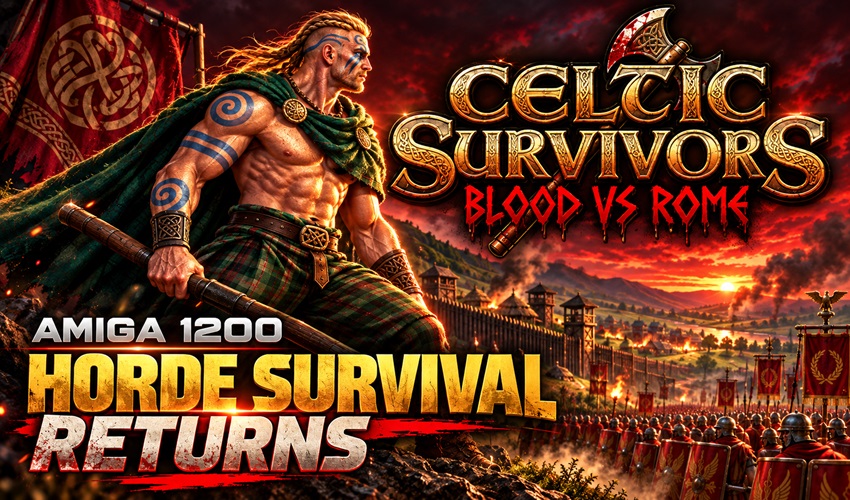
The Amiga 1200 has a new horde survival game, and Celtic Survivors: Blood VS Rome isn’t shy about putting plenty of Romans on screen. Developed by Fliegeralarm Games for AGA Amigas, Celtic Survivors borrows the basic setup familiar from Vampire Survivors. Your hero attacks on their own. You handle movement, positioning and picking upgrades. Enemies keep arriving. Runs get busier. Mistakes become expensive. There’s a twist, though. You aren’t merely trying to keep one character alive. A Celtic village sits in the middle of the fighting, and Roman troops can burn it down.
Romans at the gate
Each run starts simply enough. Move around the battlefield, avoid incoming troops and collect blood dropped by defeated enemies. Blood works as experience, letting your character level up and choose from three upgrades presented on rune stones.
Those upgrades can improve existing attacks or add new tools. A sling can join your arsenal. So can a wolfhound, a druid’s circle and barrels of mead. Some combinations can be pushed into stronger evolved forms, giving each run a bit of build planning rather than leaving progress to movement alone. The Roman army isn’t made up of one endlessly repeated enemy, either.
Basic legionaries soon share the field with torch bearers, javelin troops, shield formations, centurions, cavalry and onagers. Different units create different problems. Ranged attackers punish open ground. Shield troops can change how easily you cut through a group. Torch bearers head for the village and start fires.
Once a hut catches fire, you need to reach its doorway and put it out. Lose two thirds of the settlement and the run ends. Death ends it too, naturally. Survive for 14 minutes and Julius Caesar arrives with his guard. There’s an endless mode for players who want to keep the run going past the main encounter.
Three heroes approach the fight differently
Celtic Survivors currently gives players three heroes, each built around a different attack pattern. Caradog uses large axes circling his body. His war cry turns him into a spinning attack, making close-range crowd control his main strength. Nemain carries a sword and throws her shield through nearby enemies. Bran takes the magical route, firing lightning automatically and using a rune ability to recover health and push enemies away.
Each hero gets a personal evolution too. Bran can gain Wrath of Taranis, Nemain has War Pack and Caradog can develop Fire Axe. It means switching characters does more than swap a sprite or starting statistic. Their attacks occupy different parts of the screen, so movement changes with them. Caradog wants a different route through a crowd than Bran, and Nemain’s shield gives her another way to deal with groups pressing in.
The map matters
There are three main battlefields. One places the fight around a fortified village. Another moves events to a winter camp beside a frozen river. The third takes place in a sacred grove without defensive walls. Rain and fog can change visibility and battlefield conditions during a run.
Useful structures sit around the maps too. The village well restores health. The forge improves the axe. A stone circle recharges Caradog’s war cry. Between enemy waves, players can spend time preparing the settlement. Pits can be dug, thorn hedges planted and damaged huts repaired. Prisoners can be freed, adding archers to the palisade, and chests provide extra rewards.
This pushes Celtic Survivors away from being a straight copy of the familiar survivor formula. You’re moving through crowds and stacking upgrades, but part of your attention stays on the settlement and its weak points.
Silver carries between runs
Progress doesn’t disappear when a run ends. Silver collected during play can be spent in the druid’s shop on permanent bonuses and new heroes. Ten deeds provide extra goals, and optional rule sets can change the conditions of a run. Blood Moon, Fog Night, No Axe and Ironman are among the available modifiers, with harder restrictions bringing greater rewards.
A chronicle records encountered heroes and Roman units, and the final tally screen keeps track of each run’s performance. There’s local two-player support too. Caradog and Nemain can fight together on the same Amiga, turning the already crowded battlefield into a shared survival run.
Keyboard, joystick and CD32 pad controls are supported, with remappable keys available. Screen shake and flashing effects can be switched off. The game includes English and German text, spoken lines and music tied to different locations.
An Amiga 1200 game built for expanded hardware
Celtic Survivors targets the Amiga 1200 rather than the base Amiga range. It requires the AGA chipset, a 68030 running at 25 MHz or faster, 2 MB of Chip RAM, 4 MB of Fast RAM and roughly 14 MB of hard-drive space. Its 256-colour isometric presentation makes use of AGA hardware, and the game can fill the battlefield with hundreds of Roman soldiers during heavier encounters.
For Amiga owners searching for a current action release, Celtic Survivors: Blood VS Rome mixes survivor-style automatic combat with village defence, permanent progression, character builds and local two-player play. It’s a familiar structure rebuilt around an Amiga 1200, with enough changes to give those fourteen-minute Roman assaults their own identity.
MORE AMIGA & RETRO NEWS
 Resident Evil: The Other Survivors demo confirmed for ambitious RE2 total conversion
 Dragon Slayer: The Legend of Heroes I & II brings the 1989 RPG classic back
 Company of Heroes Definitive Edition revives the 20 year old RTS with 4K and 64-bit support
 Heroes of Might and Magic III Remake brings the strategy classic back in full 3D
 Battlefield 1942 is now playable in VR with the new BFVR mod
 41 years of Commodore Amiga: 41 facts about the legendary computer
 DICE before Battlefield: how Digital Illusions grew from the Amiga Demoscene
 Amiga beyond Commodore: how outside companies built its gaming, video and software legacy
 This modder’s Ultimate Amiga 1200 turns Commodore’s classic into a retro powerhouse
 Dave Jones and DMA Design: the Amiga story behind Menace, Blood Money and Lemmings
 The Lost Vikings Amiga retrospective: three Vikings, one brilliant puzzle game
 Blood: Refreshed Supply brings the 1997 cult shooter back from the dead
 World Heroes Perfect Steam release revives a cult Neo Geo fighting game
 Micronik Infinitiv 1200: Amiga 1200 tower case history, specs, price and legacy
 The 50 best Amiga games of all time: a nostalgic journey through the Commodore era