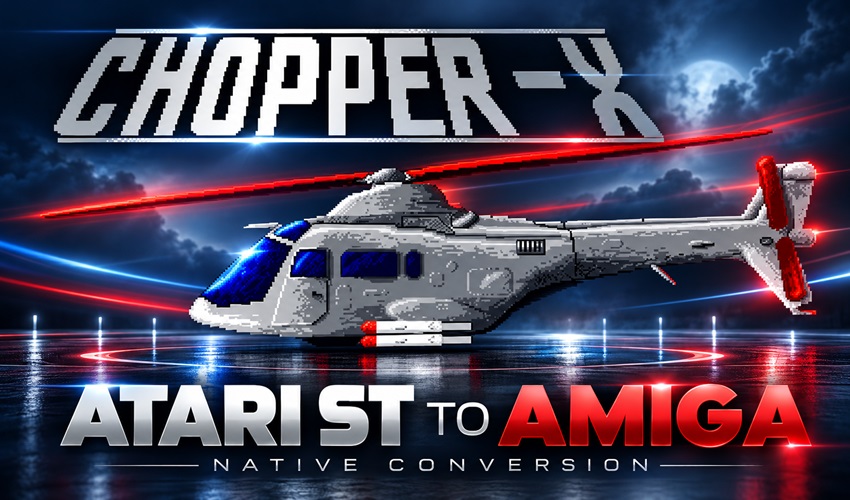
Chopper X has reached the Amiga, and there’s a twist in how it got there. This isn’t a new game built to resemble an old Atari ST shooter. Developer MrDig has taken the original game, replaced the routines tied to Atari hardware and got its Motorola 68000 code running directly on Commodore’s Amiga computer. The scrolling action remains intact, with new control options and high-score saving. It’s a direct port, with an unusual technical story.
Before the helicopter reached Amiga
Chopper X began as an Atari ST release from developer Paradox and publisher Eidersoft, later joining Mastertronic’s budget range. Janko Mršic-Flögel handled its programming, design, music and sound, with graphics by Mungo Amyatt-Leir.
The game follows arcade helicopter shooters such as Toaplan’s Tiger-Heli. You fly a Heward XX66 attack helicopter on a mission against the enemy base at Dang Ban Fu, moving up a vertically scrolling battlefield packed with military targets.
Tanks, boats, aircraft and fixed installations fill the route. Your main weapons are twin air-to-ground missiles, with cluster bombs available for wider attacks. Those bombs aren’t unlimited. To replenish your supply, you have to steer over white crosses on the battlefield. There are eight stages to complete, with refuelling between missions. A panel keeps track of your score, remaining helicopters and bombs. Finish the campaign and you can enter the Hall of Fame.
Same processor, different machine
The Atari ST and Amiga share a Motorola 68000 processor, which gave MrDig a practical starting point. Instead of recreating Chopper X from screen recordings or making the Amiga emulate an Atari ST, the project uses the game’s existing machine code. The Atari executable was disassembled and rebuilt, with around 30 targeted changes covering hardware access and extra functions. Most of the work involved graphics, sound, input and storage.
Chopper X still builds its images in the Atari ST’s original screen format. On Amiga, the Blitter converts these images into the bitplanes required by Commodore’s display hardware. The Copper takes care of switching display buffers, and scrolling work moves from the main processor to the Blitter. Colours are mapped from the Atari ST palette to the Amiga’s colour range. The graphics themselves haven’t been redrawn.
Sound needed its own solution. The original game used the Atari ST’s YM2149 chip, so its music and effects now run through the Amiga’s Paula hardware. The conversion recreates the three tone voices, envelopes and noise effects, keeping the original sequences without claiming identical output from two different sound chips. The optional MIDI output from the ST edition isn’t part of this port. Timing stays unchanged, too. Chopper X updates its display every fifth frame, and the Amiga conversion preserves this behaviour rather than speeding things up on faster systems.
New ways to play and save
A joystick in the second port handles movement and missiles. Cluster bombs use the space bar or a second joystick button, which makes compatible CD32 pads useful here. P pauses the action; Escape returns you to the title screen.
Function keys provide optional cheats for unlimited helicopters, unlimited bombs, invulnerability and skipping stages. Any score earned using these options stays out of the Hall of Fame. High-score saving is part of the Amiga conversion too. It works in the floppy and WHDLoad editions, though the standard hard disk package doesn’t save scores.
Three formats for different Amigas
There are bootable floppy, hard disk and WHDLoad packages. The floppy edition needs 1 MB of memory, and the hard disk release needs about 1.5 MB. WHDLoad offers a route into the game from an existing Amiga setup, plus a return to Workbench without restarting the computer. OCS, ECS and AGA hardware are supported, and a standard 68000 processor can run the game. Testing covers physical Amiga 500 and Amiga 1200 computers, alongside emulator configurations.
MrDig directed and tested AI-generated code, utilities and tests. The result is a non-commercial Amiga release built around the Atari ST original rather than a replacement for it. Chopper X plays through the same eight stages, using much of the same code, on a different set of chips.
MORE AMIGA & RETRO NEWS
 Air Tiger Strike brings Desert Strike-style helicopter combat to Amiga AGA
 How Atari used intellectual property to secure millions from Sega
 41 years of Commodore Amiga: 41 facts about the legendary computer
 Cobra Strike aims to revive retro helicopter combat with modern tactics
 Atari Video Music: the 1977 Atari console that turned music into TV visuals
 Why the Atari Jaguar was called 64-Bit and why that still causes debate
 How Commodore’s lawsuit slowed Jack Tramiel’s Atari computer plans
 Command & Conquer fan port brings Westwood’s RTS classic to Atari ST
 Another World on Atari XL/XE: VBXE project pushes the Atari 8-Bit limits
 SimCity 3000: Unlimited retrospective — the game that shaped modern city-builders
 Atari and Commodore are back: the old rivalry enters a new generation
 Zeewolf Amiga retrospective: Desert Strike meets polygon chaos
 Motorola 68000 to 68060 history: how the 68K family powered the Commodore Amiga
 The Atari ST: Atari’s powerful 16-Bit computer introduced in early April 1985
 The 50 best Amiga games of all time: a nostalgic journey through the Commodore era