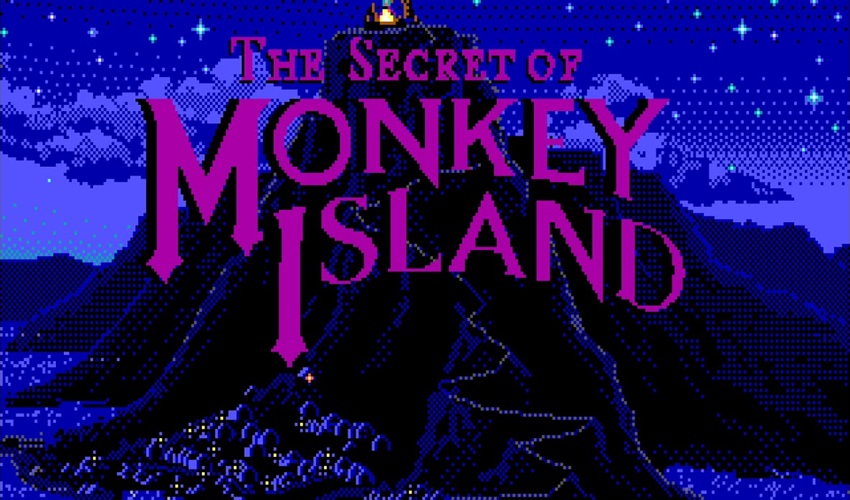
Some games never seem to run out of places to go. The Secret of Monkey Island is one of them. More than three decades after Guybrush Threepwood first arrived on Mêlée Island with dreams of becoming a pirate, Lucasfilm Games’ unforgettable adventure has found another home. This time, it’s the Sinclair ZX Spectrum 128K, courtesy of Outsoftware. And yes, it’s quite a sight. Monkey Island has always been one of those games I can return to without much persuasion. The ridiculous conversations, the strange puzzles, the characters who take themselves far too seriously. There’s something wonderfully confident about an adventure where winning a sword fight means coming up with a better insult than your opponent. Seeing Guybrush turn up on the Spectrum, a machine never originally intended to host his adventures, makes this conversion particularly interesting.
Guybrush Threepwood is still a terrible pirate
For anyone unfamiliar with the original, The Secret of Monkey Island follows Guybrush Threepwood, a young man who arrives on Mêlée Island with one ambition: he wants to become a pirate. Unfortunately for Guybrush, enthusiasm doesn’t count for much among the island’s experienced troublemakers.
Before anyone takes him seriously, he needs to complete three trials. Sword fighting, treasure hunting and stealing a valuable idol are on the agenda. Naturally, none of these tasks goes according to plan.
Things become considerably stranger once Governor Elaine Marley and the ghost pirate LeChuck enter the picture. What starts as a series of pirate lessons grows into an adventure involving mysterious islands, unusual characters and some of the most entertaining puzzles ever put into a computer game.
Ron Gilbert created the original adventure at Lucasfilm Games, with Tim Schafer and Dave Grossman contributing to its writing and design. Their work helped establish Monkey Island’s particular sense of humour, where ridiculous situations are treated with complete seriousness by almost everyone involved. Guybrush, meanwhile, rarely seems entirely in control of events. Which is probably why he’s such an enjoyable character to follow.

It’s the little moments you remember
Ask someone about Monkey Island and the conversation probably won’t begin with graphics or technical achievements. It’ll begin with a joke, a puzzle or a character. There’s the famous insult sword fighting, where quick thinking matters more than swinging a blade. There’s Stan, the impossibly enthusiastic salesman who could probably sell a sinking ship to someone already drowning. And there’s the rubber chicken with a pulley in the middle, an item so absurd it has become inseparable from the series.
These moments give Monkey Island its personality. The writing constantly finds ways to turn ordinary adventure game situations into something unexpected. A seemingly straightforward conversation can become a comedy routine, and an object sitting innocently in an inventory might eventually solve a problem nobody would approach logically.
The original adventure arrived during a period when Lucasfilm Games was helping redefine the graphical adventure genre. Its SCUMM interface replaced complicated text commands with selectable actions, giving players more room to concentrate on exploration, dialogue and problem-solving. It worked brilliantly. And the game remains entertaining for reasons extending far beyond its original presentation.
Mêlée Island gets the Spectrum treatment
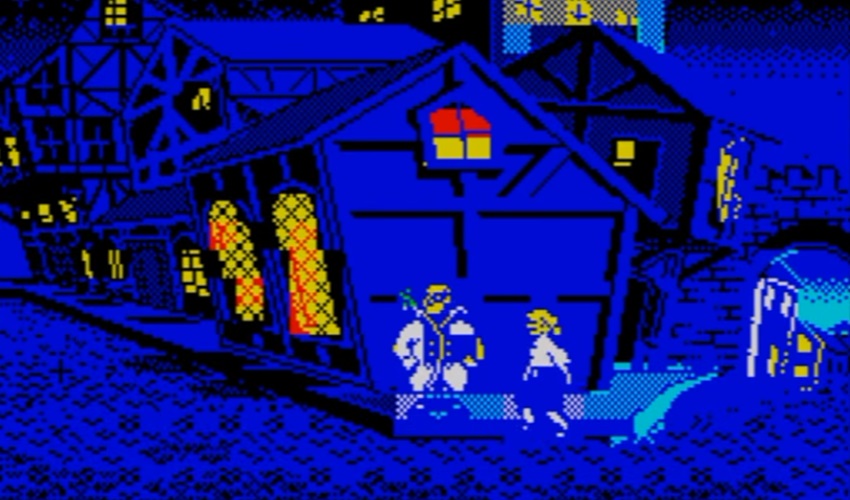
Outsoftware’s ZX Spectrum 128K conversion brings Guybrush’s adventure to a machine missing from the game’s original list of platforms. Of course, the presentation is different. The Spectrum has its own unmistakable visual character, and scenes originally created for other computers have to work within its limitations. Familiar locations take on a different appearance, but the attraction remains seeing Monkey Island’s characters, conversations and adventure structure translated into another format.
The controls are straightforward enough. Players move a pointer using Q, A, O and P, with the space bar handling selections. Walking around, choosing commands and interacting with the scenery remain central to the experience.
There is one practical requirement worth mentioning. The conversion uses floppy-disk images and needs a Spectrum 128K equipped with a +D disk interface and G+DOS, or a suitable emulator. It isn’t intended for loading from an ordinary cassette. Once the game starts, the familiar Lucasfilm Games branding and title screen introduce Guybrush’s latest appearance.
Another unlikely home for a classic adventure
Outsoftware has worked on other adventure conversions, including Maniac Mansion for the Spectrum 128K. Versions of Monkey Island are listed for the SAM Coupé and Sinclair QL, too. What makes this particular conversion enjoyable to follow is the choice of game. Monkey Island isn’t an obvious candidate for the Spectrum. It’s a dialogue-heavy adventure, filled with detailed locations, objects to collect and characters who often have plenty to say.
Yet its appeal has never depended entirely on how many colours a computer can display. It’s the writing, the carefully constructed puzzles and Guybrush’s increasingly unfortunate encounters with pirate life which make the adventure so memorable.
There are plenty of ways to play The Secret of Monkey Island today, including editions with more elaborate visuals and sound. The Spectrum version offers something different: another interpretation of a game whose characters and humour remain instantly recognisable. And somehow, Guybrush Threepwood seems perfectly at home on yet another computer he was never supposed to visit.
MORE AMIGA & RETRO NEWS
 The Secret of Monkey Island gets a full MSX2 conversion
 Escape from Monkey Island returns with an unofficial PC remaster mod
 The Secret of Monkey Island and Monkey Island 2 get PS1 beta ports
 Super Monkey Ball Dreamcast port shows promising early gameplay
 A LucasArts classic sails onto PS1 with The Secret of Monkey Island port
 ZX Spectrum and Commodore 64 are back: new hardware, old rivalry and a growing market
 Pacific Islands Amiga retrospective: tanks, tactics and ’90s strategy gaming
 The Secret of Monkey Island history: development, success, and lasting legacy
 Retro revival: The Secret of Monkey Island is being developed for the Commodore 64
 Rainbow Islands arcade-style port in development for Amiga AGA
 The 50 best Amiga games of all time: a nostalgic journey through the Commodore era
 The surprising origin of Guybrush Threepwood’s name in Monkey Island
 What happened to LucasArts? The rise and closure of a legendary game studio
 Why return to Monkey Island’s announcement is a big deal
 Monkey Island 2: Gorgeous graphics and atmospheric adventure game