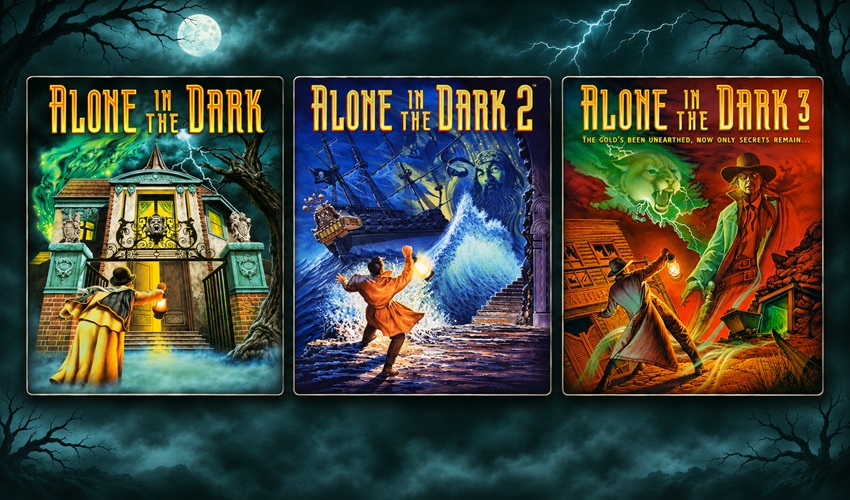
There’s something about the original Alone in the Dark I’ve always found fascinating. Those angular characters, the strange camera perspectives and the constant uncertainty over what might be waiting behind the next door. It’s a very different kind of horror from what we’re accustomed to today, and one I’d happily revisit. With Alone in the Dark: Classic Reborn, there’s now a considerably more convenient way to play the original adventures on modern computers. The free source port supports the original trilogy and the short Jack in the Dark spin-off, introducing widescreen support, modern controller options, graphical improvements and numerous gameplay fixes. Better still, it doesn’t try to reinvent the games. Edward Carnby remains every bit the awkward polygonal detective he was in the early 1990s.
Before survival horror became a household name
It’s easy to associate survival horror with Resident Evil, but Infogrames was experimenting with many of its defining mechanics several years earlier. Released in 1992 for MS-DOS, Alone in the Dark was an unusually ambitious production from French designer Frédérick Raynal, combining three-dimensional characters with pre-rendered scenery, fixed camera perspectives and environmental puzzles.
What I particularly appreciate about the original game is its willingness to surprise the player. Entering a seemingly ordinary room could lead to an unexpected encounter, and carrying a weapon didn’t necessarily mean you were prepared for it.
Set in Louisiana in 1924, the game follows Edward Carnby or Emily Hartwood as they investigate the mysterious death of Jeremy Hartwood at the Derceto mansion. Its supernatural fiction draws heavily from H. P. Lovecraft, with exploration and puzzle-solving taking precedence over gunfights.
Alone in the Dark 2 arrived in 1993 with a stronger focus on action, followed by the Western-themed Alone in the Dark 3 in 1994. Jack in the Dark, released between the sequels, placed young Grace Saunders inside a supernatural toy shop.
A new engine for some very old nightmares
Classic Reborn builds upon the earlier Free in the Dark and Re-Haunted projects, reconstructing the original engine for contemporary operating systems. There’s no need for DOSBox, and you won’t have to spend time experimenting with emulator configurations before starting a game.
I’m particularly pleased to see a dedicated launcher included. Each adventure has its own configuration options, covering everything from screen resolution and language preferences to audio and controller settings.
The project addresses numerous problems involving graphics, sound and gameplay. It leaves the original stories, environments and puzzles intact, which is precisely what I’d want from a project of this nature.
Giving those familiar rooms a graphical upgrade
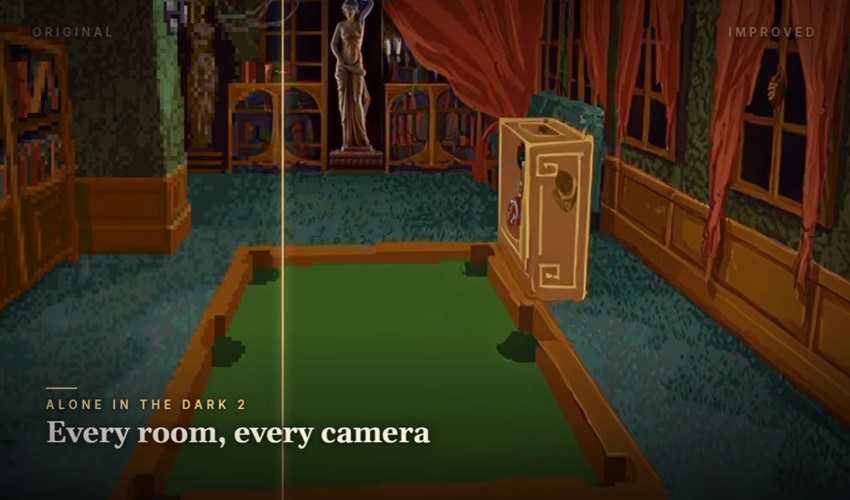
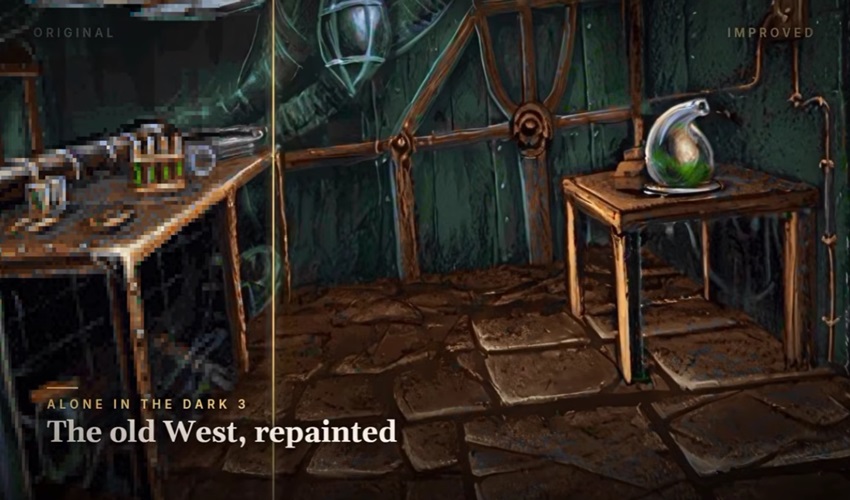
The graphical improvements are perhaps the most immediately noticeable additions. Classic Reborn introduces adjustable resolutions, widescreen support and improved rendering of the original character models, alongside optional effects such as anti-aliasing, bloom, ambient occlusion, film grain and CRT scanlines. Higher-resolution scenery packs are available for players interested in giving the environments a cleaner appearance. You can download selected packs directly through the launcher.
Personally, I’m rather fond of the original low-resolution scenery. There’s a peculiar atmosphere to those early computer-generated interiors, and I’m glad Classic Reborn doesn’t force players to replace them. The traditional aspect ratio and original graphics remain available, with the newer effects entirely optional.
Finally, a choice of movement controls
For everything I enjoy about Alone in the Dark, its movement controls aren’t necessarily something I’d defend with quite the same enthusiasm. Manoeuvring Carnby around a piece of furniture can become an adventure of its own.
Classic Reborn supports Xbox, PlayStation and Nintendo Switch controllers, alongside configurable keyboard inputs. An optional analogue movement system lets characters move in the direction of the analogue stick, though traditional tank controls remain available for anyone accustomed to them.
Quick turns, controller vibration and optional cheats feature among the other additions. Players can adjust music, dialogue and sound effects independently, with compatible editions offering a choice between AdLib music and CD audio.
Available for Windows, Linux and Android
Alone in the Dark: Classic Reborn is free to download, but you’ll need to supply the original game files yourself. Steam and GOG editions are supported, alongside compatible original CD releases. The launcher supports existing GOG save games, too. The project offers native Windows and Linux versions, with experimental builds for macOS and Android. The latter includes touchscreen controls and external controller support.
As someone with a particular fondness for early survival horror design, Classic Reborn is exactly the sort of project which catches my attention. I’m especially pleased to see the sequels included, rather than another release concentrating exclusively on the 1992 original. It’s a good excuse to spend a few evenings with Edward Carnby again, preferably with the lights turned down.
MORE AMIGA & RETRO NEWS
 Battlefield 1943 Reborn brings online multiplayer to Windows and Linux
 Alone in the Dark gets an unexpected Sega 32X port over 30 years later
 More than 30 years later, Alone in the Dark is finally heading to Amiga
 C&C Generals Zero Hour Reborn overhauls graphics, AI, controls and multiplayer
 Black Jewel Reborn alpha released for Sega Mega Drive and Genesis
 Perfect Dark enters VR with new unofficial Meta Quest and PCVR port
 Dark Lands for PlayStation Vita brings dark fantasy combat to Sony’s classic handheld
 White Creek preview: a new retro survival horror game for Sega Dreamcast fans
 FEED IT Steam demo preview: Indie psychological horror with a monster to feed
 Qwak Reborn revives the fast, frantic spirit of Amiga platform gaming
 Unofficial Silent Hill PC version Brings Konami’s horror classic to Windows
 PHASE ZERO preview: classic PS1-style survival horror reborn
 The Road of Dust and Sorrow preview: old-school horror, pixel art and a desperate fight to survive
 Dungeon Lurker revives 90s PC gaming with a dark roguelike twist
 Resident Evil Veronica Remake brings Claire Redfield back into the dark