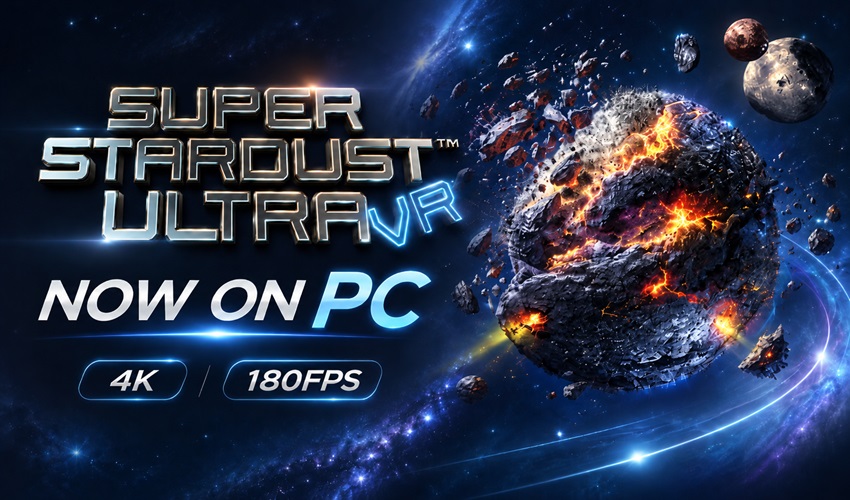
Sony’s fast-paced PlayStation arcade shooter has found its way to Windows and Linux through an unofficial PC conversion. Higher frame rates, sharper graphics and new control options are part of the package, but VR support is still missing. Super Stardust Ultra VR has made an unexpected appearance on PC, ten years after its original PlayStation VR release. An unofficial conversion, released in November 2026, brings the arcade shooter to Windows and Linux with support for 4K resolution, frame rates reaching 180fps and a range of settings absent from the original console version. It’s a welcome change of platform for a game built around quick reactions, endless incoming enemies and the constant pursuit of a better score. There’s one rather obvious catch, though. Super Stardust Ultra VR doesn’t currently support PC virtual reality headsets. For now, you’ll be playing on a conventional monitor.
Small spaceship, big problems
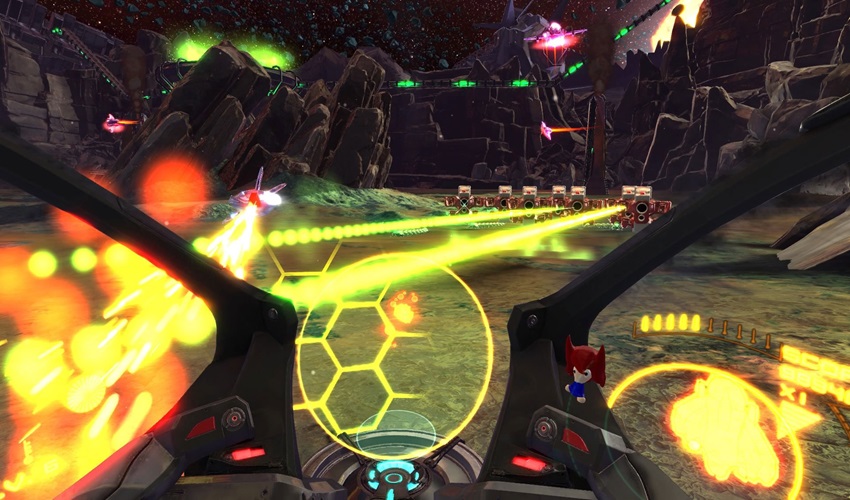
Super Stardust Ultra doesn’t waste much time getting started. You’re placed in control of a small spaceship circling a planet, with incoming asteroids and enemy craft arriving from practically every direction.
The controls are straightforward. One analogue stick moves your ship, the other handles shooting. You can switch weapons, grab upgrades and use bombs to clear the screen when things get out of hand. And they frequently do.
What starts as a manageable stream of enemies can quickly become a screen full of explosions, debris and incoming fire. Your ship needs to keep moving, and choosing the right weapon for each situation can make a considerable difference.
There’s more to play than the main Arcade mode. Survival tests how long you can stay alive, Time Attack puts the clock in charge, and other modes change the rules without losing the series’ familiar shooting mechanics. It’s the sort of game where a short session can easily turn into several attempts at beating your previous score.

A PlayStation series with a long history
Super Stardust has been around for decades, but its modern form became widely recognised with Super Stardust HD on PlayStation 3 in 2007. Developed by Finnish studio Housemarque, the game established the spherical arenas and twin-stick shooting associated with the series. It became one of the early downloadable highlights of the PlayStation 3 generation.
Super Stardust Ultra followed on PlayStation 4 in 2015, developed by British studio d3t in collaboration with Sony’s XDev team. It introduced updated graphics, extra planets and several gameplay modes.
A year later, Sony released Super Stardust Ultra VR for the original PlayStation VR headset. It retained the traditional overhead shooting and introduced Invasion Zone, a first-person mode placing players inside the spacecraft’s cockpit. The new PC conversion takes the 2016 VR edition as its foundation, bringing the game to modern computers without requiring full PlayStation 4 emulation.
Sharper graphics and smoother shooting
The biggest attraction of the PC release is its expanded selection of graphics settings. Players can choose native resolutions ranging from 720p to 4K, with 1080p and 1440p included. Higher resolutions offer a cleaner image, particularly on larger monitors where the original console output can appear softer.
There’s a substantial choice of frame rates too. The game supports 30, 60, 90, 120, 144 and 180fps, opening the door to much smoother gameplay on high-refresh-rate displays. The conversion adjusts the game’s timing to accommodate these settings, preventing the action from automatically speeding up at higher frame rates. Actual performance still depends on your hardware, and selecting an unsuitable frame-rate target can slow the game down.
Other additions include windowed, borderless and fullscreen modes, VSync controls and optional image sharpening. There’s a settings menu for making adjustments, plus an option to skip the original headset checks and opening screens.
Plenty of ways to play
Controller support covers Sony’s DualShock 4 and DualSense alongside Xbox-style gamepads. Keyboard controls are available too, but mouse aiming hasn’t been implemented. For a twin-stick shooter, a gamepad remains the obvious choice.
The PC version retains local two-player options, including cooperative and competitive modes. You’ll need two connected controllers for multiplayer sessions. There are cheats for players interested in experimenting without worrying about their remaining lives. Options include invulnerability, unlimited bombs, infinite lives and fully upgraded weapons.
What about VR support?
Here’s the main limitation. The PC conversion doesn’t currently work with PC VR headsets, so the original virtual reality experience isn’t available. It’s an unusual situation for a game with VR in its title, particularly since the PlayStation version included a dedicated first-person cockpit mode.
There’s another consideration. This isn’t an official commercial PC release, and the conversion doesn’t contain the original game files. Players must supply their own decrypted copy of Super Stardust Ultra VR.
Compatibility testing has focused on the European PlayStation 4 version, CUSA05951, release 1.00. Other versions may encounter crashes or unexpected problems. Windows 10, Windows 11 and compatible Linux distributions are supported. Steam Deck users have an installation option through Desktop Mode.
For now, Super Stardust Ultra VR on PC is best understood as a conventional version of Sony’s arcade shooter with modern display options and broader hardware support. It retains the fast shooting, crowded arenas and score-chasing gameplay of the PlayStation release. The virtual reality experience remains absent, but players interested in the traditional Super Stardust gameplay now have another way to play it.
MORE AMIGA & RETRO NEWS
 Super Metroid recomp brings the SNES classic to Windows and Linux
 Akira Nishitani wants to rework Super Street Fighter 2 Turbo after 30 years
 Super Turrican Director’s Cut restores the game Factor 5 originally planned
 GKD 350H Ultra price, specifications and features confirmed
 Sega Super Scaler explained: Hang-On, Space Harrier, OutRun and the rise of fake 3D
 From pocket PC to Sega Dreamcast: the complete history of Windows CE
 Ultra Blazer 26: new C64 arcade shooter for retro gaming fans
 Super Street Fighter II Turbo on Commodore 64: new C64 update shows serious progress
 Need for Speed III: Hot Pursuit retrospective: why the PlayStation classic still matters
 Windows 3.0 vs MacOS, AmigaOS and TOS: the 1990 desktop battle that changed computing
 Killzone: the forgotten PlayStation exclusive that still deserves a revival
 Could Akiko have saved the Amiga CD32 from PlayStation and Sega Saturn?
 50 Amazing games you can play on AmigaOS 4 and AmigaOne computers
 50 Classic Commodore 64 games that made the C64 the king of 80s gaming
 The 50 best Amiga games of all time: a nostalgic journey through the Commodore era