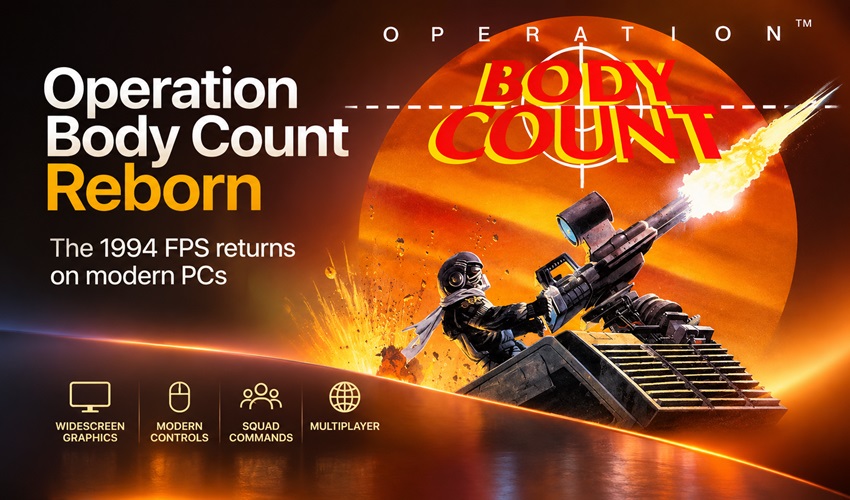
Operation Body Count wasn’t exactly the biggest name in PC gaming during the 1990s. Released at a time when Doom was dominating the first-person shooter market, Capstone Software’s unusual mix of terrorists, mutant rats and squad-based gunfights struggled to attract the same attention. More than three decades later, it’s getting another chance on modern computers. Operation Body Count Reborn, or OBCR, brings the old DOS shooter to Windows and Linux, with widescreen graphics, modern controls and multiplayer support.
A terrorist crisis with an unusual beginning
The original Operation Body Count arrived in 1994, running on an upgraded version of the Wolfenstein 3D engine. Capstone had added a few interesting features, including textured floors and ceilings, destructible scenery and computer-controlled teammates.
The story is pure 90s action material. Terrorists have seized a United Nations building in the fictional year 2012, taking diplomats hostage. You’re sent in with an elite military squad to clear the building and rescue them. Simple enough. Except the mission doesn’t begin with terrorists.
Instead, the opening levels throw players into underground sewers crawling with giant rats and mutants. It’s a strange introduction for a military shooter, but one perfectly suited to an era when developers weren’t particularly concerned about keeping their enemies within the same genre.
Eventually, the action moves into the occupied building, where armed terrorists replace the creatures. Across 40 levels, players fight through corridors, offices and increasingly dangerous encounters, using everything from conventional firearms to flamethrowers and grenade launchers.
Old graphics, modern screens
Operation Body Count Reborn isn’t trying to reinvent any of this. The original campaign remains the centre of the experience, complete with its familiar enemies, weapons and level layouts. The biggest difference becomes apparent as soon as the game starts. Instead of being restricted to the original 320 × 200 resolution, players can choose modern display settings, including widescreen formats such as 16:9 and 21:9.
There’s optional texture upscaling for walls, weapons and enemies, alongside improvements to floor and ceiling rendering. Movement appears smoother, and the game makes better use of contemporary monitors.
Prefer the original pixel-heavy presentation? That’s still an option. The changes are noticeable without turning the game into something unrecognisable. Corridors retain their angular construction, enemies remain sprite-based, and combat follows the same straightforward rules.
Shooting without fighting the keyboard
The control changes could prove more significant than the graphics. Anyone who’s played an early DOS shooter will be familiar with the occasional struggle of adapting to older keyboard layouts. OBCR replaces much of this friction with WASD movement and mouse aiming, making combat closer to what PC players expect from an FPS.
Controller support is included, with vibration available on compatible gamepads. The familiar weapons are still present. Machine guns and shotguns handle conventional encounters, with grenades, a flamethrower and a grenade launcher offering heavier options. Destructible walls and environmental hazards remain part of the action, giving players something to think about beyond keeping their crosshairs on enemies. The overhead map, music, sound effects, cutscenes and saving system have been carried across, too.
Don’t forget the squad
One of the more interesting parts of Operation Body Count was its attempt at squad-based combat. You’re not permanently restricted to a single soldier. Computer-controlled teammates can accompany you through the levels, and basic commands let you direct their movements. You can order them to follow, spread out or switch control between individual squad members.
It’s a fairly simple system compared with later tactical shooters, yet it gives the game a different rhythm from the endless solo firefights common in its day. Multiplayer receives attention in OBCR as well. The port supports local network and Internet play, with matches accommodating up to 12 players. Deathmatch, team-based modes and direct two-player connections are available. It’s a welcome practical change for a shooter whose original networking options belong to the dial-up era.
A second chance for Capstone’s peculiar FPS
OBCR runs natively on 64-bit Windows and Linux, although players must supply the original commercial game files. The port doesn’t contain the copyrighted game data. What remains is a distinctly 1994 first-person shooter, complete with questionable enemy combinations, cramped corridors and plenty of ammunition. There’s no attempt to disguise its age or replace its original ideas with modern ones.
Instead, Operation Body Count Reborn removes many of the technical inconveniences standing between modern PC players and Capstone’s game. It’s still a shooter about climbing through a terrorist-occupied building, clearing rooms and occasionally wondering why a giant mutant rat was involved in the first place. Only now, you can do it in widescreen with a mouse in your hand.
MORE AMIGA & RETRO NEWS
 Battlefield 1943 Reborn brings online multiplayer to Windows and Linux
 Terra Nova Plus improves the 1996 PC classic with smoother combat and modern controls
 Doody Calls: Turd World War gives Amiga owners a new AGA action game
 Sega’s cult classic Phantasy Star has made a surprise comeback
 C&C Generals Zero Hour Reborn overhauls graphics, AI, controls and multiplayer
 Black Jewel Reborn alpha released for Sega Mega Drive and Genesis
 Twilight Princess Courage Reborn development build adds 4K and ultrawide
 Idiocracy enters the retro gaming scene as Count Binface demands Shenmue 4
 Qwak Reborn revives the fast, frantic spirit of Amiga platform gaming
 Nightdive brings back SiN: Reloaded with new trailer and playable PC demo
 Turok: Origins preview – why this sci-fi dinosaur shooter deserves attention
 The rise and fall of Tom Clancy games: how Ubisoft lost the tactical soul
 50 Amazing games you can play on AmigaOS 4 and AmigaOne computers
 50 Classic Commodore 64 games that made the C64 the king of 80s gaming
 The 50 best Amiga games of all time: a nostalgic journey through the Commodore era