
Some games receive a few graphical improvements and call it an update. Defender of the Crown 2026 goes much further. Nearly 40 years after Cinemaware released its medieval strategy game on the Commodore Amiga, this extensively reworked edition by developer Chezbas arrives with playable Norman lords, bigger battles, new action sequences and a surprising amount of extra strategy. Much of the original artwork has received attention too, and the changes extend into areas of the game which have remained largely untouched since 1986. And there’s plenty to talk about. The familiar struggle for control of medieval England remains at the centre of everything. You choose a commander, gather troops, conquer provinces and take enemy castles. Only now, there’s considerably more to manage between battles, and your opponents have a few new tricks of their own.
It started with the Amiga in 1986
Defender of the Crown was one of the first games to demonstrate the graphical capabilities of Commodore’s Amiga. Released by Cinemaware in 1986, it mixed territorial strategy with jousting, sword fighting and castle sieges, presenting the action through detailed illustrations rarely encountered on home computers at the time.
Kellyn Beeck designed the game, James D. Sachs created its celebrated artwork, and Jim Cuomo composed the music. Together, they helped establish the distinctive Cinemaware presentation, where cinematic scenes played an important role alongside traditional gameplay.
The original game had its limitations. Battles were relatively simple, strategic options were restricted, and experienced players could work out effective methods of conquering England fairly quickly. Defender of the Crown 2026 takes those familiar mechanics and gives players much more to do.
You can finally fight for the Normans
Here’s one of the biggest changes. You aren’t restricted to the Saxons anymore. The new edition introduces four playable Norman commanders, including Reginald Front-de-Boeuf and Philip Malvoisin. Choosing a Norman lord changes your starting position, your enemies and the circumstances surrounding the campaign.
Robin Hood isn’t going to help you either. Norman commanders receive Viking assistance instead, with a longship appearing off England’s southern coast. Reinforcements are available on a limited number of occasions, giving players another tactical option during difficult campaigns. It’s an interesting change to a game originally built around the Saxon perspective, and it opens up fresh possibilities without replacing the familiar structure.
The battles have become much more interesting
Anyone who’s played the original will remember its rather basic battlefield encounters. Two opposing armies met, the numbers changed, and the outcome was decided. Things are different now.
Defender of the Crown 2026 introduces animated soldiers whose presence reflects the size of the opposing forces. Casualties appear during combat, armies can retreat, and defensive garrisons take part in battles.
This gives military decisions more weight. Leaving soldiers to defend a province now serves a practical purpose, particularly when enemy commanders begin attacking vulnerable territory. Castle raids have received attention too, with updated sword-fighting sequences, improved scenery and visible health indicators.
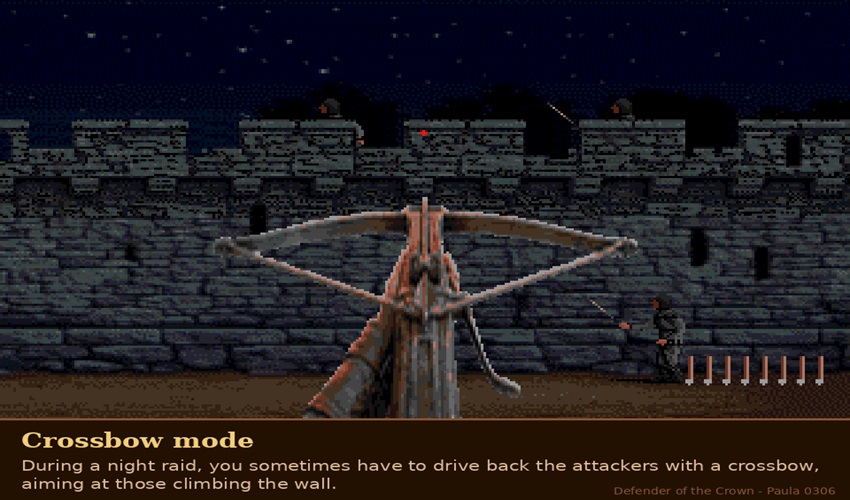
There’s a completely new crossbow sequence, involving the defence of a prison during a nighttime attack. Players aim using the mouse, firing across scrolling battlements as attackers approach. It’s another piece of action in a game already famous for switching between strategy and arcade sequences.
There’s more happening between battles
The changes don’t end when the fighting stops. Players can now construct castles and prisons, maintain defensive garrisons and increase their monthly income through buildings. Captured nobles introduce ransom payments and rescue attempts, creating situations beyond the usual business of conquering another province.
Managing your territory has become a bigger part of the campaign. A new information panel, accessed with the right mouse button, provides details about provincial income, troops and prisoners. Recruitment is quicker too, thanks to improvements to the mouse controls. None of this changes the basic objective. You’re still trying to control England. But you’ll spend more time making decisions about the provinces you’ve already conquered.
The artwork has received serious attention
There’s plenty happening on the visual side. Castle interiors, forests, courtyards and siege camps feature revised backgrounds. Flames flicker, clouds move, shadows have been improved, and colour-cycling effects bring additional movement to several scenes.
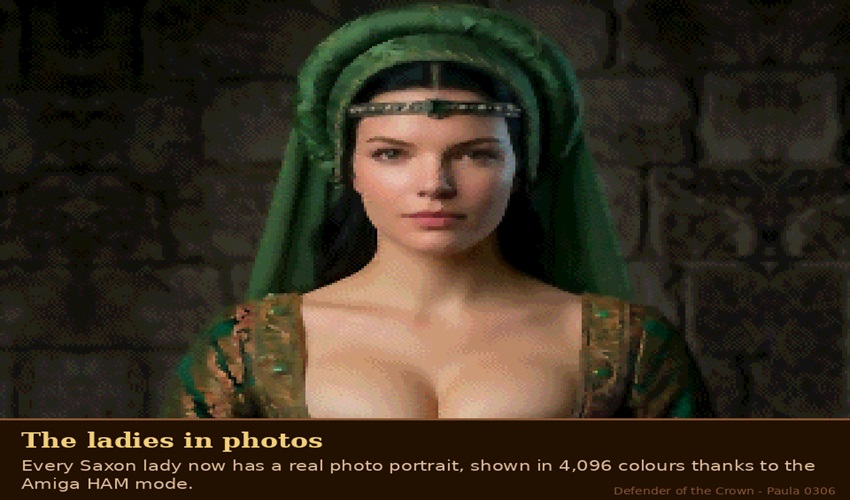
Some character portraits use the Amiga’s Hold-And-Modify graphics mode, better known as HAM, allowing more colour detail in selected illustrations. The changes are noticeable without turning Defender of the Crown into a completely different-looking game. Its familiar medieval artwork remains central to the presentation.
Language support has grown too, with English, French, German, Italian, Spanish, Dutch and Swedish included. The expanded content now occupies three Amiga disk images in ADF format. Graphics and program data use compression, and improvements to audio handling help maintain music during transitions between scenes.
A considerably bigger Defender of the Crown
What makes Defender of the Crown 2026 interesting isn’t one particular improvement. It’s the sheer number of changes across almost every part of the original experience. The new Norman campaigns offer another perspective on the war for England. The revised battles introduce more visible action and tactical decisions. Buildings, prisoners and additional management options give players more to think about between military campaigns.
And the improved graphics bring extra detail to the scenes which helped make the original game famous. Four decades after its first appearance, Defender of the Crown has received an extensive overhaul which goes well beyond the usual visual update. It’s still recognisably Cinemaware’s medieval strategy game, only with considerably more happening both on the battlefield and behind the castle walls.
MORE AMIGA & RETRO NEWS
 Dragon’s Crown Pro gets an unofficial PC port with 4K graphics and online co-op
 Defender of the Crown returns to Amiga with improved combat and new features
 What if Commodore had abandoned everything except Amiga?
 Castlevania: Symphony of the Night, the secret behind 200.6% completion
 Defender of the Crown: The Legend Returns released on Steam with Amiga retro mode
 41 years of Commodore Amiga: 41 facts about the legendary computer
 Amiga beyond Commodore: how outside companies built its gaming, video and software legacy
 THEA1200 reveal gives first real look at the long-awaited Amiga 1200 remake
 Amiga classic Defender of the Crown returns with august 2026 release date
 50 Amazing games you can play on AmigaOS 4 and AmigaOne computers
 50 Classic Commodore 64 games that made the C64 the king of 80s gaming
 The 50 best Amiga games of all time: a nostalgic journey through the Commodore era
 One of the most iconic Amiga games is coming back: Defender of the Crown Remaster announced
 Which Amiga games are worth playing in 2022?
 The 10 best Amiga 500 games that defined Commodore’s classic computer