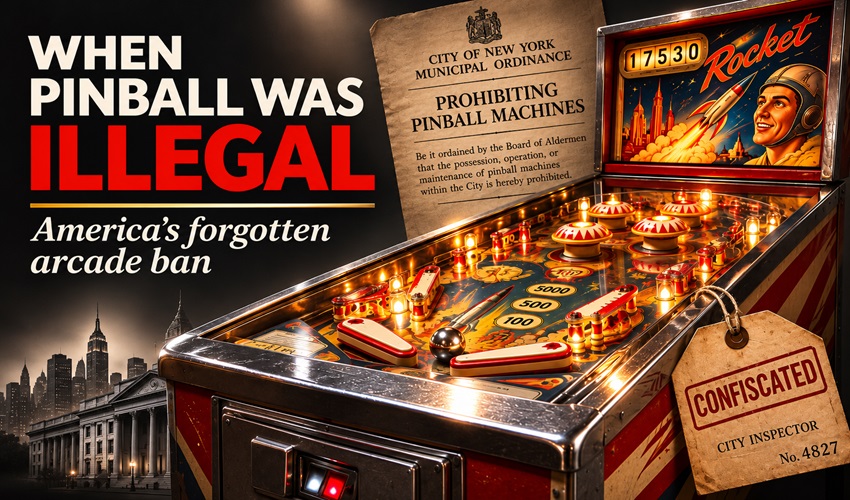
Picture a police officer walking into a New York bar in 1942. He’s not interested in the drinks or the customers. He’s there for the pinball machine sitting in the corner. The machine gets seized. Others meet a worse end, smashed in public as city officials wage war against a form of entertainment now found in arcades and bars across America. It sounds ridiculous from a modern perspective. Yet pinball was illegal in New York City for 34 years. Los Angeles and Chicago had their own bans, and the people making these machines spent decades fighting restrictions on their business. So how did a steel ball, a few flashing lights and a coin slot become such a problem?
Pinball had a gambling problem
The story begins in the 1930s, when pinball machines started appearing in bars, shops and amusement venues across America. Early pinball was quite different from the game people recognise today. There were no flippers. You inserted a coin, launched the ball and watched it bounce around the playfield. Getting a good score relied heavily on luck.
Some operators offered cash or prizes for winning scores. Others converted free games into payouts. It wasn’t difficult to see why police started paying attention. For local authorities, pinball occupied an awkward space between amusement and gambling. Children could spend their pocket money chasing scores, and machines occasionally operated as convenient gambling devices. Los Angeles voted to ban pinball in 1939. New York City followed in January 1942. And New York took the job seriously.
New York declares war on a steel ball
Mayor Fiorello La Guardia hated pinball. He regarded the machines as gambling equipment connected to organised crime, with young players among the easiest customers to exploit. His administration ordered police raids on establishments operating them. Officers confiscated cabinets, and officials arranged public demonstrations of their destruction.
Machines were broken apart. Metal was collected for wartime production, giving the campaign a practical justification during the Second World War. For business owners, the message was clear. A pinball machine could bring unwanted police attention.
Yet there was something strange about the situation. Pinball wasn’t illegal throughout America. Rules changed from city to city, leaving manufacturers selling perfectly ordinary amusement machines in one market and facing prohibition in another. The industry carried on, but its biggest problem wasn’t going away.
A small invention changes everything
In 1947, Gottlieb introduced a machine called Humpty Dumpty. Its big attraction was simple. Flippers. For the first time, players could actively redirect the ball using electrically operated controls. Early flipper arrangements were different from modern layouts, but the idea worked. Players could practise shots, improve their timing and influence their scores.
Later machines placed flippers near the bottom of the playfield, creating the familiar pinball experience.
Suddenly, it wasn’t simply a question of luck. Manufacturers kept improving the machines, introducing new scoring features and rewards such as extra balls and free games. Cash payouts weren’t required for the game to work. Yet cities continued enforcing laws written during an earlier period of pinball’s development. The machines had changed. The regulations hadn’t.
The player who helped legalise pinball
Los Angeles saw its prohibition overturned through a California Supreme Court ruling in 1974. New York’s breakthrough came two years later, through a rather unusual public demonstration. In April 1976, writer and experienced pinball player Roger Sharpe appeared before New York City councillors. His task was straightforward, at least on paper. He needed to demonstrate pinball was a game of skill.
Sharpe explained how players controlled the ball, aimed their shots and developed techniques through practice. He called a particular shot and successfully sent the ball where he’d intended. One shot couldn’t explain every part of pinball, but it made the argument difficult to ignore. Councillors voted to legalise the game. Mayor Abraham Beame signed the measure in June 1976. After 34 years, New Yorkers could legally play pinball again, subject to city regulations.
Pinball enters a different arcade era
Chicago lifted its ban in January 1977, opening another major market for the industry. The timing was interesting. Pinball was moving into its electronic age. Mechanical scoring systems were giving way to solid-state technology, and manufacturers were experimenting with more elaborate rules and features. Video games were arriving, too.
For arcade operators, pinball was no longer primarily a legal argument. It was a commercial decision. Did a machine attract enough players? Could it compete with the latest video cabinet? Was the maintenance worth it?
The old bans disappeared at different speeds, through court decisions, changes in local law and a growing acceptance of pinball as skill-based entertainment. It’s an odd chapter in gaming history. A machine once treated as a gambling threat eventually became a routine part of the arcade business. Nothing about the steel ball had made it harmless overnight. Players had gained more control, the hardware had improved, and lawmakers had finally reconsidered what the machines actually did.
MORE AMIGA & RETRO NEWS
 Mega Pinball Fantasies brings the Amiga classic to Sega Mega Drive and Mega-CD
 Pinball Illusions finally gets its missing Vikings table on Amiga AGA
 Pinball Fantasies: Encore revives the Amiga pinball classic for Windows, macOS and Linux
 Pokémon Pinball: Diamond & Pearl gives the GBA classic new Pokémon and more
 18 years later, Midnight Club: Los Angeles has finally made it to Windows and Linux
 Why Digital Illusions spent six months on Pinball Dreams ball physics for Amiga
 GTA Online Casino ban leaves Australian players locked out
 Space Cadet Pinball now runs on the Nintendo 64
 DICE before Battlefield: how Digital Illusions grew from the Amiga Demoscene
 Gears of War returns on PC with the ambitious Gears of War Redux overhaul mod
 Appulse preview: pinball meets roguelite shooting in Raw Fury’s new PC action game
 Need for Speed III: Hot Pursuit retrospective: why the PlayStation classic still matters
 SimCity 3000: Unlimited retrospective — the game that shaped modern city-builders
 The 50 best Amiga games of all time: a nostalgic journey through the Commodore era
 Valve hit with New York lawsuit over loot box gambling in Counter-Strike 2