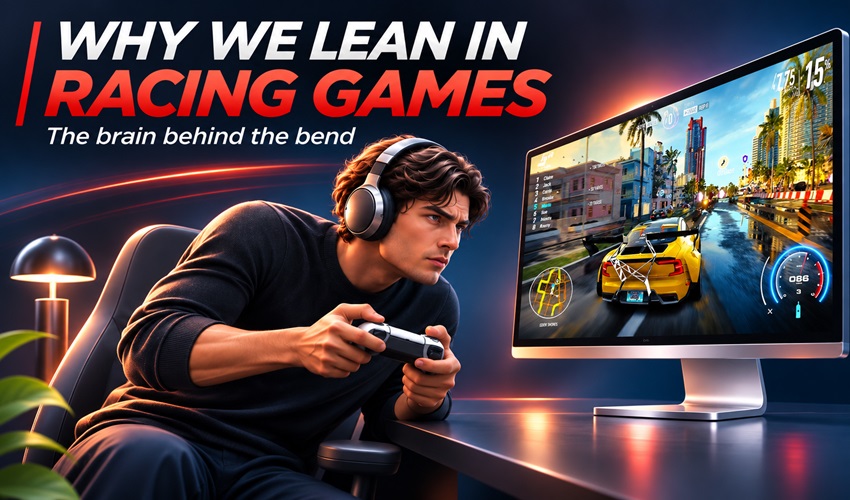
You’re flying down the final straight in Gran Turismo. There’s a sharp corner ahead, you’re carrying too much speed, and the barriers are getting uncomfortably close. You hit the brakes, pull the controller to one side and lean across the sofa. Your shoulders move. Your head tilts. For a split second, you’re physically trying to help a car you aren’t actually sitting in. We’ve probably done it more times than we’d care to admit. It’s a strange little habit. You can spend hours playing racing games without leaving your chair, yet a difficult corner can have you shifting your entire upper body. Nobody’s pushing you sideways. There’s no actual acceleration. The television certainly isn’t moving. So what’s going on inside your head?
Your eyes can trick your brain into moving
Your brain spends much of its time working out where you are and how you’re moving. It uses your eyes, inner ears, muscles and joints to piece everything together. In an actual car, those signals usually agree. You see a corner approaching, the vehicle turns, and your inner ear picks up the change in motion. Gaming is a different story.
Your eyes see the road sweeping left or right. Buildings shoot past. The horizon shifts across the screen. Yet your body is sitting perfectly still, probably with a controller resting somewhere near your lap. Your brain has to make sense of two very different messages.
There’s a name for part of this experience: vection. It’s the sensation of movement created by watching something move around you. Ever sat on a train and thought you’d started moving, only to realise the train beside you was pulling away? It’s a similar trick. Racing games can tap into this effect, particularly with large screens and cockpit cameras filling your vision with moving scenery.
Your body remembers what a corner means
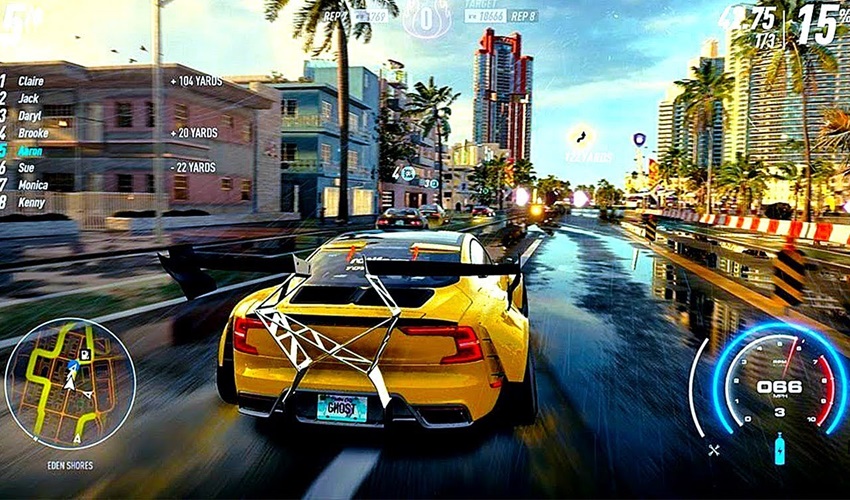
Here’s where things get interesting. Your brain doesn’t need to genuinely believe you’re driving a car for your shoulders to start moving. It already has plenty of experience connecting corners with physical reactions. Think about riding in a car through a tight bend. Your body experiences sideways forces, and you might brace yourself, adjust your posture or shift against the movement.
During a racing game, your eyes recognise a familiar situation. A corner is approaching. You’re going fast. You need to turn. Your brain starts preparing for what it expects. Sometimes this preparation spills into your shoulders, neck and upper body. You might lean before the virtual car has reached the apex. It’s less about being fooled completely and more about your brain responding to a situation it has encountered in real life.
The harder the corner, the more you move
Watch someone playing a racing game during a relaxed lap. They might barely move. Now put them on the final lap, chasing first place, with a difficult hairpin coming up. Suddenly, their shoulders are involved. There’s a connection between concentration and physical movement. When you’re trying to place a car precisely on the road, your eyes follow its direction, your hands make corrections and your body can join the action.
It’s especially noticeable during unexpected slides or near misses. Of course, leaning sideways won’t rescue your car in Forza Motorsport. A standard controller doesn’t care where your shoulders are pointing. Your brain doesn’t always keep those physical responses separate from the task on screen. And players aren’t identical. Some barely twitch during a crash. Others move across their chairs during every difficult turn.
Bigger screens make things more convincing
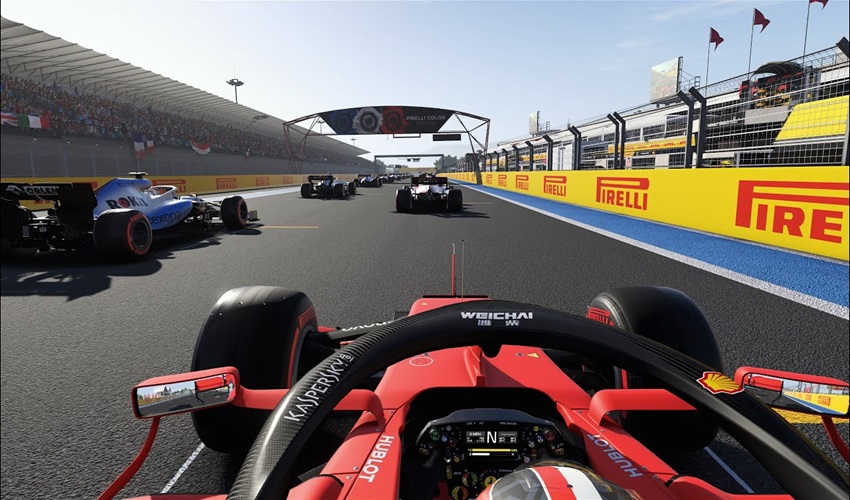
Screen size can change the experience considerably. Play a racing game on a small monitor and you can still see much of the room around you. Move to an enormous curved display or a triple-monitor racing setup, and far more of your vision becomes occupied by the circuit.
Your eyes receive more movement information. A steering wheel with force feedback adds another physical connection. You can experience resistance through your hands as the virtual car corners or loses grip.
Virtual reality takes things further. Turn your head and the cockpit moves naturally with your viewpoint. The road stretches around you instead of sitting inside a rectangular screen. For some players, these stronger visual cues make the experience more convincing. They can contribute to simulator sickness, too, especially when the eyes report movement the inner ear can’t confirm.
So why can’t we sit still?
There’s no single explanation for every little lean during a racing game. Sometimes it’s your eyes responding to moving scenery. Sometimes it’s anticipation. Sometimes you’re concentrating so intensely on holding a racing line your shoulders follow your hands.
Usually, several of these processes are happening together. The interesting part is how little conscious thought goes into it. You aren’t making a deliberate decision to move your body. You want the car around the corner, and somewhere between seeing the bend and turning the controller, your muscles get involved.
Next time you’re fighting through a tight corner in Mario Kart or trying to save a slide in Gran Turismo, pay attention to your posture. You might discover you’ve spent half the race steering with your shoulders.
MORE AMIGA & RETRO NEWS
 8 Eyes makes a comeback with a 16-bit remake and Legacy Collection
 Real Racing 3 is running on PS Vita more than a decade after launch
 Classic 1995 racing game Fatal Racing returns with a new PC release
 Virtua Racing arrives on PC & Xbox with 4K and eight-player support
 How the Commodore Amiga helped Brainlab pioneer brain-surgery research
 Colin McRae Rally retrospective: the 1998 PlayStation classic that redefined rally racing
 Sega Super Scaler explained: Hang-On, Space Harrier, OutRun and the rise of fake 3D
 Inside Virtua Racing: Sega’s SVP chip and the Mega Drive’s most ambitious cartridge
 Atari Mindlink and telepathy: the weird history of Atari’s “mind-control” game
 Need for Speed III: Hot Pursuit retrospective: why the PlayStation classic still matters
 The man who made racing games feel real: Geoff Crammond’s legacy
 Need for Speed Underground 2 Unreal Engine 5 project brings back the street racing classic
 Amiga racer Spirit of Eternal Racer returns with big update
 50 Amazing games you can play on AmigaOS 4 and AmigaOne computers
 The story behind Formula One Grand Prix: the Amiga racing game that changed sim racing