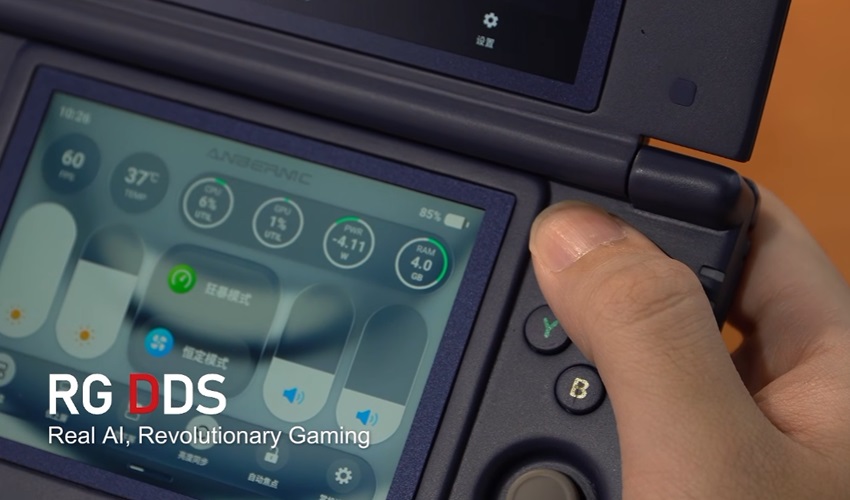
There’s something genuinely exciting about Anbernic’s upcoming RG DDS. I’ve been particularly interested in the company’s decision to build a dedicated Android interface around two screens instead of relying on familiar software arrangements. With shipments starting on 10 December 2026, Anbernic has released a new video showcasing its DDS Launcher, and the software is quickly becoming one of the most interesting aspects of this clamshell gaming handheld. The Snapdragon processor and dual IPS displays caught my attention from the beginning, but I was equally curious about how Anbernic would bring everything together. Having two screens is one thing. Making them genuinely useful is another.
The DDS Launcher is what I’ve been waiting to see
Android gaming handhelds often share remarkably similar software experiences, regardless of their hardware. Anbernic is taking a different approach here, introducing its own launcher with dedicated support for the RG DDS’s two displays.
Games, applications, widgets and system settings share a unified interface, with pre-installed emulators covering more than 30 gaming platforms. It’s particularly encouraging to see Anbernic investing time in software rather than treating Android as something users need to configure entirely themselves.
One of the more interesting moments in the demonstration involves Nintendo 3DS emulation running at three times its original rendering resolution. I’m curious to see how consistently the RG DDS manages more demanding titles, especially during extended gaming sessions. A short demonstration can’t answer every performance question, but it’s an encouraging starting point.
Serious hardware beneath the clamshell
Anbernic has chosen Qualcomm’s Snapdragon G2 Gen 2 for the RG DDS. The eight-core processor uses a 4 nm manufacturing process and features Adreno A22 graphics, placing the handheld considerably above many of Anbernic’s cheaper Android devices.
There are two memory configurations available. The standard edition features 8 GB of RAM and 128 GB of internal storage, with the more expensive model offering 12 GB and 256 GB respectively. Both run Android 16 and support microSD cards with capacities of up to 2 TB.
Connectivity includes Wi-Fi 6, Bluetooth 5.4 and USB-C video output at up to 1080p. Anbernic has included an internal cooling fan and heat pipe, giving the processor active cooling during demanding emulation sessions. I’m particularly interested in how much noise the cooling system produces and whether the handheld remains comfortable during longer periods of use.
Two screens are the real attraction here
The display arrangement is probably my favourite aspect of the RG DDS. Anbernic hasn’t simply placed two identical panels inside a clamshell housing. Instead, the company has chosen different screen sizes and aspect ratios, closely matching the requirements of Nintendo 3DS emulation.
The upper 4.7-inch IPS display runs at 1,200 × 720 pixels with a 5:3 aspect ratio. The lower 4-inch touchscreen features a resolution of 960 × 720 pixels and a 4:3 aspect ratio. Both offer 500 nits of brightness, a pixel density of 300 ppi and a 60 Hz refresh rate.
I’d have loved to see AMOLED technology here, particularly with the competing Retroid Pocket Duo offering 120 Hz AMOLED displays, but Anbernic’s choice of screen proportions interests me considerably more than the refresh rate alone. The RG DDS weighs 434 grams and measures 166 × 93 × 26 mm. Its physical controls include analogue sticks, a directional pad, face buttons, shoulder buttons and a retractable stylus.
Some genuinely interesting software additions
I’m less interested in the generative AI features than some of Anbernic’s more practical software additions. Real-time text translation could prove useful for Japanese games, and voice commands offer another method of adjusting volume and brightness. The ability to convert the lower touchscreen into a multitouch trackpad caught my attention, too. It’s a clever addition for Android applications without proper physical controller support.
Anbernic’s control centre provides independent brightness adjustments for each display, alongside cooling options, performance profiles and audio settings. These are precisely the sort of smaller details I’m interested in seeing manufacturers develop further.
Pricing and a December release
Anbernic has fitted the RG DDS with a 6,000 mAh battery supporting 27 W charging, stereo speakers, a 3.5 mm headphone connection and automatic sleep functionality upon closing the lid. Pre-orders start at $284.99 for the 8 GB model, with the 12 GB edition costing $349.99. Colour options include Basalt Black, Glacier White and Phantom Blue.
Shipments begin on 10 December 2026, and I’m genuinely curious to see how the finished handheld performs outside Anbernic’s demonstrations. For me, the biggest attraction isn’t another impressive specification sheet. It’s seeing Anbernic experiment with a different hardware format and develop software around it. The RG DDS is certainly a handheld I’ll be following closely this December.
MORE AMIGA & RETRO NEWS
 Anbernic’s retro handhelds face US copyright scrutiny over bundled games
 Retroid Pocket Duo vs Anbernic RG DS Plus: dual-screen handhelds compared
 Anbernic RG DS Plus gets 4X DS Scaling, dual screens and a new Linux OS
 Gaming handhelds and RAM: How much memory do you actually need?
 Anbernic RG SP revealed with slimmer design and H700 power
 New ARMSX2 Refresh release improves PS2 emulation on Android
 Why China dominates retro handheld gaming: inside Anbernic, Miyoo and Powkiddy
 Retroid Pocket Nova is a pocket-friendly Android gaming handheld built for retro players
 Android gaming enters new territory with shadPS4 PS4 emulation
 AYANEO Pocket Micro 2 first look: Snapdragon upgrade targets better emulation
 Anbernic strengthens retro handheld support with spare parts program
 Anbernic brings Linux to the RG DS, giving its dual-screen handheld a second life
 Android handhelds are growing up, and GammaOS Next is leading the way
 Anbernic RG Vita Pro review: a comfortable retro handheld with a Vita-style design
 Anbernic RG Rotate: everything you need to know before launch