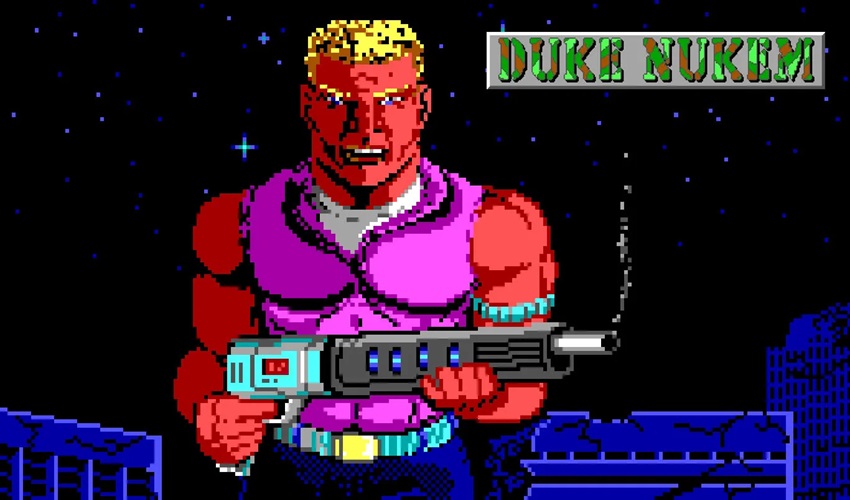
Before the sunglasses, outrageous one-liners and alien-infested streets of Los Angeles, Duke was a platform-hopping action hero with a gun and an unhealthy number of robots standing in his way. Developer serpentchain has brought this earlier incarnation of the character to the FPGA-based computer with Duke Nukem Next, an unofficial conversion of Apogee Software’s MS-DOS platformer. It’s the original game with its familiar graphics, sound effects and level designs.
Duke Nukem before the first-person shooter
I’ve always found the original Duke Nukem particularly interesting. It’s easy to associate the character with first-person shooters, but his earlier adventures offered a very different kind of action, with platform jumping, secret passages, weapon upgrades and plenty of mechanical enemies.
Duke Nukem Next features Shrapnel City, the opening episode of the original PC game. Serpentchain has retained the original graphical assets, right down to the colourful industrial machinery, destructible objects and robotic opponents occupying its environments.
The original DOS game used EGA graphics with a resolution of 320 × 200 pixels and a palette of 16 colours. I’m pleased the developer has kept the artwork intact rather than replacing it with modern graphics. Those chunky sprites and colourful environments are an instantly recognisable part of Duke’s first adventure, and seeing them running on a Spectrum-derived computer is particularly interesting from a technical perspective.
Ten levels of shooting, jumping and exploration
Dr Proton is causing trouble again. The scientist has assembled an army of robotic machines called Techbots, leaving Duke with the unenviable task of destroying his creations and stopping his plans for global domination.
What I particularly like about the original game’s design is how much attention it gives to exploration. You can’t simply hold down the fire button and expect to reach the exit. Locked doors, hidden passages and platforms require players to investigate their surroundings, collecting keys and equipment along the way.
Shrapnel City contains ten levels, with health pickups, weapon upgrades and bonus items scattered throughout its environments. Destroying security cameras and discovering hidden objects contribute to your score, giving you plenty of reasons to investigate areas you might otherwise pass over. It’s an interesting combination of arcade shooting and methodical platforming, particularly when compared with the more aggressive approach of Duke’s later adventures.
Where the Duke Nukem series began
Apogee Software introduced Duke Nukem during the early 1990s, when MS-DOS computers were developing an increasingly interesting catalogue of action games. The company’s shareware distribution model gave players an entire introductory episode before asking them to purchase the registered edition. The complete game featured three episodes: Shrapnel City, Mission: Moonbase and Trapped in the Future. Each contained ten levels, bringing the registered edition to 30 stages.
Duke Nukem II continued the series with more elaborate graphics, additional weapons and revised gameplay mechanics. Duke Nukem 3D eventually transformed the character into one of PC gaming’s biggest personalities, moving the action into first-person environments through the Build engine.
For me, the original platformer remains an interesting part of Duke’s history. Its mechanics have surprisingly little in common with his later adventures, yet the character’s appetite for destruction was already present.
Duke Nukem on the ZX Spectrum Next
The technical side interests me almost as much as the game itself. The ZX Spectrum Next features an FPGA-based Z80N processor operating at speeds of up to 28 MHz, hardware sprites, extended memory and improved graphical and audio facilities. Considering the architectural differences between the original IBM-compatible PC and the Spectrum Next, it’s an intriguing choice for a conversion.
Duke Nukem Next comes in a single 480 kB executable file, supports keyboard and joystick controls and follows a pay-what-you-want distribution model. It contains the complete Shrapnel City episode, with its ten levels and two bonus musical tracks.
For anyone whose interest in Duke Nukem extends beyond his first-person shooter adventures, this unofficial ZX Spectrum Next conversion offers an opportunity to experience a very different chapter of the series.
MORE AMIGA & RETRO NEWS
 Someone has brought Duke Nukem 3D to the Sega 32X, and it actually runs
 Duke Nukem 3D runs on the SNES Doom engine after 18 months of development
 Duke Nukem: Land of the Babes is escaping the PS1 after 26 years
 Duke Nukem 3D can now be viewed from multiple angles in real 3D
 Duke Nukem Advance returns on PC as a Duke Nukem 3D mod
 This new Duke-RT release gives Duke Nukem 3D a stunning graphics upgrade
 Duke Nukem on Atari ST: the original DOS shooter finally reaches Atari’s 16-bit computer
 How Ken Silverman’s Build engine shaped Duke Nukem 3D and 90s FPS design
 Duke Nukem: Zero Hour review – the forgotten N64 exclusive revisited
 Bobby Prince, legendary composer of DOOM, Wolfenstein 3D and Duke Nukem 3D, has died
 ZX Spectrum and Commodore 64 are back: new hardware, old rivalry and a growing market
 Duke Nukem 3D looks like a modern remaster thanks to new path tracing mod
 Hail to the king: Duke Nukem 3D returns to Amiga with PiStorm optimization
 50 Amazing games you can play on AmigaOS 4 and AmigaOne computers
 Hail to the King, Baby: Duke Nukem 3D at 30 — the FPS that gave games attitude