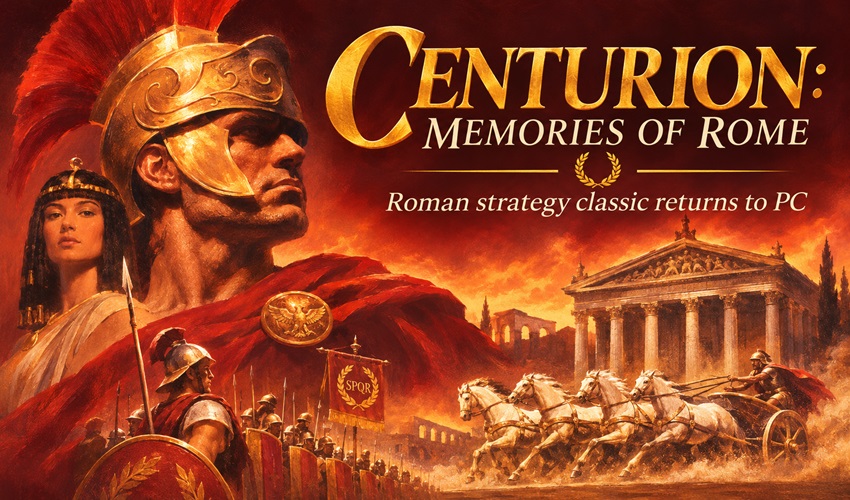
You start with one legion, a single province and an ambition stretching across the Mediterranean. It’s 275 BC, Rome is still finding its feet, and there’s an empire to build. Centurion: Memories of Rome brings the 1990 strategy game Centurion: Defender of Rome to modern Windows PCs, complete with Amiga graphics, familiar battles and a few welcome changes to how everything works. More than three decades after its original release, Roman conquest is on the menu again.
Before Total War, there was Centurion
Released in 1990 by Electronic Arts, Centurion: Defender of Rome came from developer Bits of Magic and designer Kellyn Beck. It arrived during an interesting period for PC strategy games, when developers were experimenting with ways to bring different types of gameplay into the same experience.
Centurion mixed turn-based empire management with real-time battles. You could spend one moment deciding where to send your legions and the next watching soldiers clash on a battlefield. There were gladiator fights, chariot races and naval engagements too. It was an ambitious combination for a DOS game.
The Commodore Amiga and Sega Mega Drive received their own versions in 1991. Now, independent developer Von Django has brought the original concept to Windows with Centurion: Memories of Rome.
Conquering Rome’s neighbours is only the beginning
The campaign opens in 275 BC. Rome controls one province, and your military strength consists of a single legion. It’s not much to work with. The objective is straightforward: spread Roman control across the Mediterranean. Getting there involves raising armies, collecting taxes, securing new provinces and deciding when diplomacy might work better than another expensive military campaign.
Money matters. Soldiers cost money, military improvements aren’t free, and conquered territories need attention. Taxation helps finance expansion, but pushing a province too hard can cause unrest.
You can’t spend endlessly on new legions without thinking about the consequences. Centurion: Memories of Rome keeps these systems intact. The differences become apparent through the interface, where selecting legions, issuing movement orders and checking recruitment costs have become easier.
There’s a new dated journal too, recording battles, invasions, promotions, casualties and spending. As Roman territory grows, it gives players a clearer record of what’s happening across the campaign.
The battles have received some attention
Land battles remain one of Centurion’s main attractions. Once opposing armies meet, the turn-based campaign gives way to real-time combat. You select formations, position soldiers and issue orders as enemy troops advance. It’s a different pace from managing provinces.
The new Windows version introduces movement indicators, including blue dotted lines showing where soldiers are heading and red routes marking pursuit orders. Pathfinding has received changes, helping troops move around obstacles and occupied positions. Players can inspect opposing armies before selecting their own formations, making the opening moments of battle easier to plan.
There’s a visual change worth mentioning too. Soldiers disappear from their units as casualties mount, with fallen troops remaining on the ground. A badly damaged formation now makes its losses more apparent.
Gladiators and chariot races are still here
Centurion was never entirely interested in conventional strategy. Its gladiator contests, naval encounters and chariot racing gave players something different to do between military campaigns. Those sections return in Memories of Rome, accompanied by changes to controls and presentation.
Gladiator combat receives more responsive inputs, revised animation timing and clearer information about audience reactions. Chariot racing provides extra guidance for corners, acceleration and choosing the right lane.
Touch-screen controls have been introduced for certain activities, including naval combat and racing. The result is still recognisably Centurion, with the same mixture of empire management and arcade-style action.
Old graphics, new Windows compatibility
One of the more interesting decisions concerns the visuals. Rather than creating an entirely new appearance, Von Django has combined the DOS campaign with converted graphics and music from the Amiga version.
Character portraits, sprites and other visual elements retain their original style. The game runs directly on Windows without DOSBox. Players can switch between full-screen and windowed modes using Alt+Enter, with the original image proportions maintained.
Audio options include original and higher-quality music, separate volume settings and additional sound effects. Keyboard remapping is available, alongside Xbox-compatible controller support for land battles. Extra instructions have been introduced for players getting to grips with combat. It’s a collection of smaller changes rather than a complete redesign.
A 1990 strategy game with a new PC release
Von Django used AI-assisted programming during development, working on code modifications, interface changes and new features alongside testing. Centurion: Memories of Rome is available as an approximately 113 MB download for Windows. Players extract the archive and launch the game through its executable file.
The underlying campaign remains familiar. Rome starts with limited territory, neighbouring regions present opportunities for conquest, and military expansion requires money, planning and attention to provincial affairs.
For anyone interested in the history of PC strategy games, Centurion offers an example of how developers combined several genres long before large-scale historical warfare became a familiar part of the PC gaming market.
Memories of Rome doesn’t attempt to turn the 1990 original into a modern strategy blockbuster. It keeps the old campaign, introduces a more convenient way to play and leaves the business of building a Roman empire in the player’s hands.
MORE AMIGA & RETRO NEWS
 Supremacy makes its return to Windows, Linux and AmigaOS 4
 Celtic Survivors: Blood VS Rome turns the Amiga 1200 into a Roman battlefield
 What if Commodore had abandoned everything except Amiga?
 Empire: Total War still has great mods, here are the best ones
 Atre: Dominance Wars preview: apocalyptic 4X strategy meets godlike ambition
 Windows 3.0 vs MacOS, AmigaOS and TOS: the 1990 desktop battle that changed computing
 MicroProse on the Amiga: flight sims, strategy classics, and the rise of serious gaming
 New Analogue 3D firmware is the update N64 fans have been waiting for
 Pacific Islands Amiga retrospective: tanks, tactics and ’90s strategy gaming
 Civilization Amiga retrospective: how Sid Meier’s masterpiece captured a generation
 Thirty years on, The Settlers II remains a masterclass in strategy design
 North & South (1989): the classic civil war strategy game – gameplay, history, and legacy
 50 Amazing games you can play on AmigaOS 4 and AmigaOne computers
 50 Classic Commodore 64 games that made the C64 the king of 80s gaming
 The 50 best Amiga games of all time: a nostalgic journey through the Commodore era