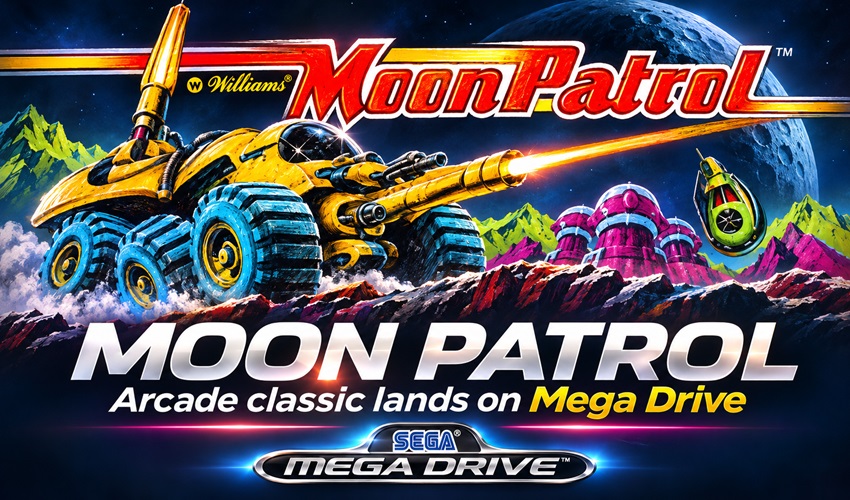
Moon Patrol doesn’t give you much time to settle in. One moment, a six-wheeled buggy is rolling across the moon. The next, there’s a crater in the road, a rock ahead and something firing from the sky. Your hands are busy before you’ve had a chance to admire the scenery. More than four decades after Irem’s arcade game arrived in 1982, Moon Patrol has made its way to Sega’s Mega Drive and Genesis through a new adaptation from indie developer ShinobiZ. It keeps the familiar mix of driving, jumping and shooting, with some useful extras. The idea remains wonderfully straightforward. Getting through a stage is another matter.
One buggy, several problems
Most driving games ask you to watch the road. Moon Patrol insists you watch the sky, too. Your buggy moves across uneven ground at a speed you can adjust, giving you a little control over how quickly trouble arrives. You jump craters, clear rocks with forward shots and fire upwards at approaching enemies.
There’s a lot happening for a game with such a small set of actions. Jump too early and you risk landing where the ground disappears. Spend too long dealing with an enemy overhead and the next obstacle can catch you. Each section becomes a short test of timing, especially once the course starts adding fresh hazards to familiar stretches.
ShinobiZ’s version includes the Beginner and Champion courses, including later Champion runs. Checkpoints still break up the route, so progress comes in manageable bursts rather than one uninterrupted dash. The original title screen and attract-mode sequences are present, along with a status display styled around the arcade game.
A familiar game with a few useful extras
On Mega Drive, the controls fit a standard three-button pad, with support for six-button controllers. Left slows the buggy, right speeds it up, A makes it jump, and B or C fires. It’s the sort of layout you can learn in seconds. You’ll need to.
There’s room to change things, too. The options menu lets players remap buttons, choose a starting sector and adjust lives and bonus-life settings. High scores, section records and preferences can be saved through cartridge SRAM, provided the emulator or flash cartridge supports it.
There’s a generous little concession after a failed run. Pressing Start before the countdown ends continues from the previous checkpoint, restoring lives but resetting the score. Your section time carries over. It gives players another attempt at the difficult stretches without pretending the previous run never happened. The music runs through the Mega Drive’s own sound hardware, and the game is strictly single-player.
Why the 1982 arcade game matters
The original Moon Patrol arrived from Irem in 1982, with Williams Electronics distributing it in North America. Takashi Nishiyama designed a game built around an unusual pairing: the rhythm of a scrolling shooter and the immediate hazards of an obstacle course.
Its presentation did a great deal of work. Mountains moved slowly in the distance, closer scenery passed more quickly, and the road raced beneath the buggy. This layered scrolling gave the scene a sense of depth without needing three-dimensional graphics. It became a familiar visual technique in later games.
Home editions appeared for machines including the Atari 2600, Atari 5200, Commodore 64 and Apple II. Each had to account for different hardware limits, but the central idea stayed intact: keep moving, watch two directions and survive the next stretch of lunar road.
A ROM you build yourself
There’s one detail worth checking before playing. The Mega Drive adaptation isn’t supplied as a finished cartridge image. Players download the game package and ShinobiZ ROM Builder for Windows, provide the required files from the original Irem arcade game, and use the builder to generate a Mega Drive ROM.
The completed image works with compatible emulators and flash cartridges on PAL or NTSC hardware. Original arcade ROM files aren’t included, and the generated image isn’t intended for redistribution.
It’s a slightly more involved setup than opening a typical homebrew download. Once the image is ready, though, the focus returns to the same simple problem Moon Patrol introduced in 1982. There’s a crater coming. You’d better jump.
MORE AMIGA & RETRO NEWS
 Tiger Road MD brings Capcom’s 1987 arcade classic to Sega Mega Drive
 Mega Splatterhouse fan port could get an official Sega Mega Drive release
 Under a Killing Moon is coming back with restored FMV and rebuilt 3D worlds
 Latest Mega EverDrive update refines Paprium and Super 32X compatibility
 Atari TOS comes to Sega Mega CD through EmuTOS
 Moon Child 1997 returns to Windows, macOS and Linux
 Linux boots on Sega Mega Drive in impressive 16-BIT console hack
 Sega Mega Jet: the Mega Drive built for Japan Airlines
 Inside Virtua Racing: Sega’s SVP chip and the Mega Drive’s most ambitious cartridge
 Zaxxon Arcade for Atari 2600 turns an old console compromise into a retro triumph
 Maldita Castilla: Requiem Mega Drive demo v1.4 delivers tough 16-bit action
 Mega Pang for Sega Mega Drive: a new homebrew tribute to Super Pang
 Classic arcade shooter Moon Cresta gets an Amiga revival
 Sensible World of Moon Soccer: when Amiga gamers played football on the Moon in 1994
 50 Classic Commodore 64 games that made the C64 the king of 80s gaming