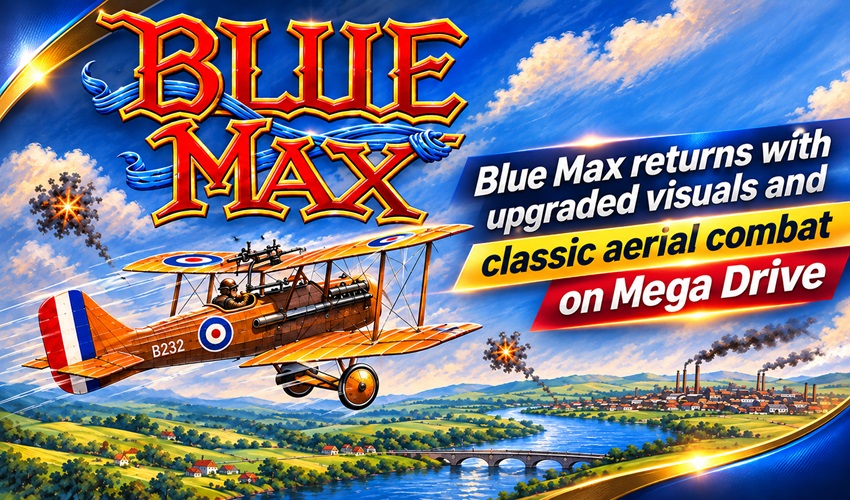
The fuel gauge never gives you much room for error in Blue Max. One aircraft ahead, a bridge below, an airfield somewhere further along the route. You can chase another target, but every extra second in the air costs fuel, and damage might leave you searching for a runway sooner than planned. More than four decades after its debut, the wartime shooter has a new Mega Drive edition, with rebuilt visuals and three-button controls. Released on 12 November 2026, Blue Max: Megadrive Remake comes from developer Gerla.cc and runs on Sega Mega Drive and Genesis hardware. It’s based on the Commodore 64 version, preserving its missions and combat rules rather than starting from scratch. It targets 60 frames per second.
Blue Max started life in 1983
Before the Mega Drive edition, Blue Max was an Atari 8-bit computer game. Bob Polin developed the original for Synapse Software in 1983, and Peter Adams handled the Commodore 64 conversion. A ZX Spectrum edition followed through U.S. Gold in 1984.
Its diagonal scrolling shared visual DNA with Sega’s arcade hit Zaxxon, but Blue Max had a distinct focus. You flew a First World War biplane over rivers, roads, bridges, military positions and airfields, attacking targets from the air and returning home.
Synapse released Blue Max 2001 in 1984, shifting the premise into science fiction. This new Mega Drive release sticks with the earlier wartime setting and takes the Commodore 64 game as its reference.
The mission still demands your attention
Blue Max doesn’t split its action into tidy dogfights. The terrain keeps moving beneath your aircraft, bringing enemy fighters, ground defences, ships and strategic targets into view. Machine guns handle aerial combat and selected surface targets. Bombs deal with bridges, installations and vehicles.
Altitude matters. Your aircraft’s shadow gives you a reference point on the ground, and dropping a bomb at the wrong moment can mean missing a target entirely. Enemy planes aren’t your only concern.
Fuel and damage shape each flight. Friendly airfields offer a place to land, repair your aircraft, replenish ammunition and refuel. Miss an approach or push too far without stopping, and a mission can unravel before you reach the enemy city. The goal remains to strike required targets, reach the city and complete the return trip.
A new camera changes the view
The biggest differences are visual. Gerla.cc has rebuilt aircraft, buildings, bridges and vehicles using graphics produced from 3D models. A revised camera presents the battlefield from a different angle, and the scrolling aims for a steady 60 frames per second.
The developers have kept the underlying dimensions and aircraft speed close to the Commodore 64 edition. Enemy appearances, fuel use, damage rules, target positions and the mission ranking system remain part of the experience.
Explosions have more visible consequences, too. Buildings collapse, destroyed vehicles remain on the ground, and bomb strikes leave craters or debris. These additions change what you see during an attack, rather than rewriting what each mission asks you to do.
Controls built for a Sega pad
The remake makes use of the three-button controller. A and C fire the machine gun; B releases bombs. The directional pad steers the aircraft, and Start handles beginning and pausing play. Normal mode uses up to climb and down to descend. Pilot mode reverses those directions, following the convention of a flight stick.
Gravity can be switched on or off, and Beginner, Advanced and Expert settings adjust the difficulty. It’s a practical set of choices for a game where altitude changes can decide whether a bombing run succeeds.
How to play Blue Max on Mega Drive
Blue Max: Megadrive Remake is distributed as a free 2 MB ROM, with an optional donation. It can run through compatible Mega Drive and Genesis emulators, including Genesis Plus GX and BlastEm, or on hardware with a suitable flash cartridge.
It’s a straightforward proposition: a 1983 aerial shooter running on Sega’s 16-bit console, with its familiar mechanics intact and a fresh graphical presentation. The route across enemy territory remains the same. What has changed is the view from the cockpit.
MORE AMIGA & RETRO NEWS
 AYN Odin 3 Portal introduces a 1TB Max model with 16GB RAM
 Max Payne 2 VR mod turns Remedy’s 2003 shooter into a full PC VR experience
 What if Commodore had abandoned everything except Amiga?
 The 80s Amiga add-on that turned a $699 computer into a $2,600 Mac
 Wings of Fear 3D: Pistons at Dawn brings 3D dogfighting to Amiga AGA
 Cobra Strike aims to revive retro helicopter combat with modern tactics
 Sega Mega Jet: the Mega Drive built for Japan Airlines
 A-10 Tank Killer retrospective: why Dynamix’s Warthog sim still matters
 Atari and Commodore are back: the old rivalry enters a new generation
 Why Gilgamech could be one of the most exciting new Sega Genesis homebrew games
 Mega Pang for Sega Mega Drive: a new homebrew tribute to Super Pang
 Contra: Hard Corps retrospective — Konami’s wildest 16-bit action game
 Max Savage preview: a retro sci-fi adventure blending Wing Commander and Zelda
 Ports of Call Amiga game history: gameplay, strategy, development and legacy
 50 Classic Commodore 64 games that made the C64 the king of 80s gaming