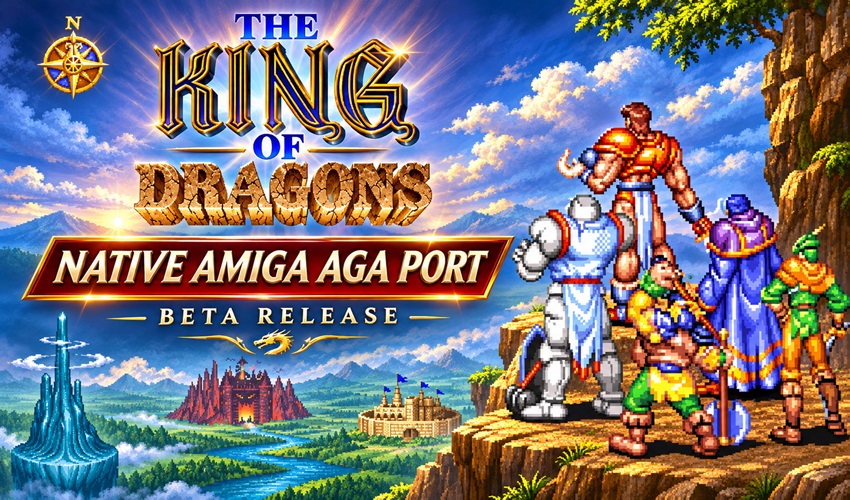
The King of Dragons is coming to Amiga, and this isn’t an arcade emulator in disguise. Capcom’s 1991 fantasy beat ’em up now has a native beta for AGA systems equipped with a 68060 processor. The original CPS1 game code runs directly on the CPU, with Amiga code handling graphics and input. It’s an exciting prospect, with some obvious limits. There’s no sound yet, the third player is missing, and the game hasn’t been tested on a physical Amiga. FS-UAE testing offers encouraging evidence: a recorded arcade run completed with zero logic mismatches.
Capcom’s fantasy fighter has plenty going on
Released in arcades in 1991, The King of Dragons takes Capcom’s familiar side-scrolling combat and drops it into a fantasy setting packed with skeletons, orcs, dragons and enormous bosses. Its 16 stages lead to a confrontation with Gildiss, a formidable red dragon.
Players choose from five classes: Fighter, Cleric, Dwarf, Elf and Wizard. Each approaches combat differently. The Fighter favours close-range attacks, the Elf relies on reach, and the Wizard attacks with magic. Experience points and equipment upgrades give the action a light role-playing twist, encouraging players to stick with a character through successive stages. The arcade original supports three players, and a Super Nintendo conversion followed in 1994. This Amiga beta currently accommodates two.
It’s the arcade code, not a recreation
The technical approach is the real story here. The port comes from F030Arcade, a project working on Capcom arcade conversions for Atari Falcon and Amiga systems. It shares its Amiga software layer with earlier work on Street Fighter II’, Final Fight and Knights of the Round.
Rather than recreating the arcade game’s behaviour from scratch, the developers run its original Motorola 68000 program directly on a 68060. Custom Amiga code handles the jobs once performed by CPS1 hardware.
On screen, the AGA chipset uses eight bitplanes, copper palette changes and chunky-to-planar conversion to draw the game. Input and interrupts receive their own Amiga handling. How fast it runs on physical hardware remains unknown.
Installation happens on the Amiga
There’s no PC conversion stage. Users copy the KOD-Amiga directory and its icon to a writable hard disk, place a compatible kod.zip archive beside the installer, and launch Install from Workbench.
The required archive is the MAME parent set for the World 910805 release. The installer checks the size and CRC-32 of each of its 16 ROM chips before building the executable on the Amiga itself. The ZIP stays in the directory afterwards, since the game reads graphics from it during play. No ROM files are included with the beta.
Two players, familiar controls and a screen warning
A 68060-class CPU, AGA graphics, Fast RAM and Workbench with IconX are required. The tested emulator configuration uses 2 MB Chip RAM, 8 MB Zorro II and 16 MB Zorro III memory, but minimum real-machine memory needs remain unconfirmed.
Keyboard players get movement, attack, jump and a combined special move, plus separate keys for player two. Joysticks work too, and CD32 pads offer dedicated controls for attack, jump, special moves and coin insertion. There are cheat keys for invincibility and boss shortcuts.
One practical detail matters: the game switches to a 15 kHz PAL or NTSC display. A VGA-only monitor needs a scan doubler or flicker fixer, regardless of the Workbench screen mode used to launch it.
Promising progress, with unanswered questions
So far, testing has taken place in FS-UAE with Kickstart 3.1, Workbench 3.1 and an emulated 68060. A recorded arcade run lasting 42,827 frames across the first four stages played through with zero gameplay logic mismatches. The installer-built executable passed the same test.
Sound is still absent. The arcade’s third-player option isn’t present, and colour accuracy and layer priorities haven’t received frame-by-frame checks against MAME. Crucially, FS-UAE doesn’t model the timing of 68060 writes to Chip RAM closely enough to predict speed on actual machines.
Physical 68060 systems and PiStorm setups using Emu68 are the next test cases. Until those results arrive, this is a working beta with clear technical progress, not a finished arcade conversion. For Amiga owners with suitable hardware, it’s a new chance to see how Capcom’s original game performs on a very different machine.
MORE AMIGA & RETRO NEWS
 What if Commodore had abandoned everything except Amiga?
 Commodore Amiga in the 1990s: AAA, AGA and the race against the PC
 41 years of Commodore Amiga: 41 facts about the legendary computer
 THEA1200 features revealed: Workbench 3.1, USB loading and RTG support
 Gloom Reforged AGA breathes new life into Commodore Amiga’s FPS history
 Super Street Fighter II Turbo on Commodore 64: new C64 update shows serious progress
 Amiga beyond Commodore: how outside companies built its gaming, video and software legacy
 Virtua Fighter Crossroads: the comeback that could reshape fighting games
 Capcom CPS3 arcade core reaches MiSTer FPGA in new beta release
 Atari Falcon 030 gets an impressive port of Capcom’s Knights of the Round
 The Phase5 story: Amiga 68060 Power, PowerPC dreams and the end of an era
 Ranko Rodic shows AGA progress on AmiCube FPGA Amiga system
 Inside THEA1200: the OS question behind Retro Games Ltd’s Amiga delay
 AGA, Chip RAM and CPU contention: the real Amiga 1200 story
 The 50 best Amiga games of all time: a nostalgic journey through the Commodore era