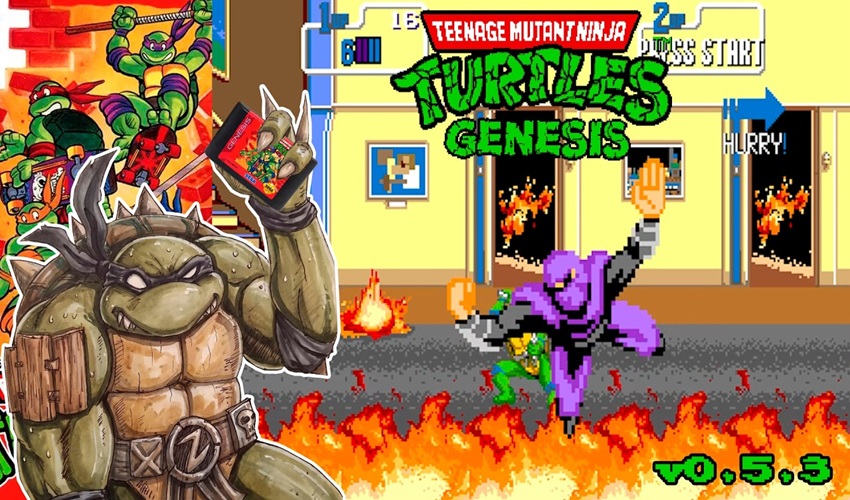
The Sega Mega Drive has no shortage of excellent beat ’em ups, but one game that always seemed to be missing was Konami’s original Teenage Mutant Ninja Turtles arcade release. Sure, we had The Hyperstone Heist, and that was a great game in its own right, but it was never quite the same experience. Now, an impressive fan-made project is bringing the 1989 arcade classic to Sega’s 16-bit console, complete with familiar stages, four playable turtles and increasingly accurate gameplay. Having spent plenty of time with Konami’s arcade games, this is exactly the sort of Mega Drive project that catches my attention.
The Teenage Mutant Ninja Turtles arcade conversion we never got
When Teenage Mutant Ninja Turtles: The Hyperstone Heist arrived on Mega Drive in 1992, it delivered the kind of fast, colourful action Konami was known for. It was an enjoyable release, but it also took a different approach to the original arcade game, with rearranged locations, altered mechanics and its own stage progression.
This new project has a different objective. Rather than recreating The Hyperstone Heist, it attempts to bring the arcade original directly to Mega Drive hardware, retaining its recognisable environments, enemy encounters and fighting mechanics.
Development is being led by Gustavo Valenzuela, better known as slash_bytes, who is responsible for programming and adapting the graphics. The conversion uses SGDK, the Sega Genesis development kit, and has been programmed without access to Konami’s original source code. SanSenpai is handling the soundtrack arrangements for the Mega Drive’s Yamaha YM2612 sound chip, while Robson Ricardo and Ray Castello contribute background artwork. (Youtube Video)
It is the kind of technically demanding conversion that makes the Mega Drive homebrew scene interesting, particularly when the goal is to reproduce an arcade game built for substantially different hardware.
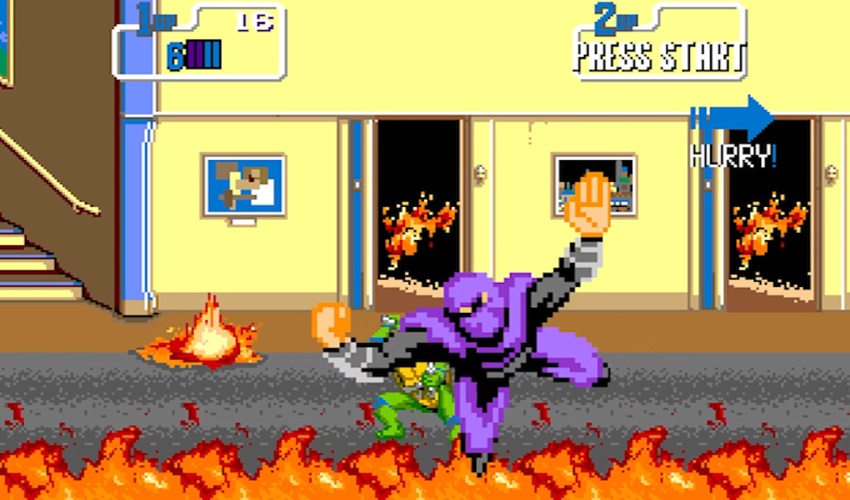
Combat improvements bring the action closer to Konami’s original
The latest development updates concentrate on something that matters far more than screenshots might suggest: how the game actually plays. Boss encounters involving Granitor, Traag and Krang have received revisions to damage calculations, invulnerability periods and attack behaviour. Krang can now be damaged during additional attack animations, while Traag benefits from adjustments to his rifle attacks and weakened-state behaviour.
Regular enemies have not been overlooked either. Foot Soldiers now respond more accurately when thrown against environmental obstacles, and several issues involving steps, scenery and collision detection have been addressed.
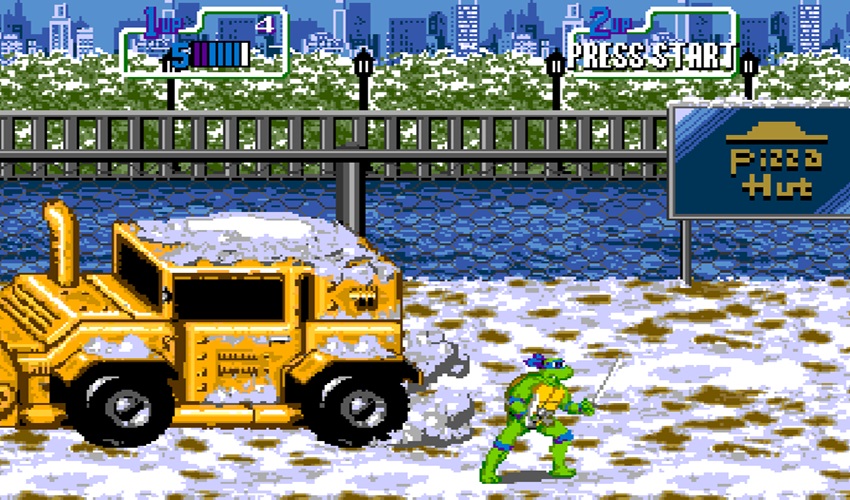
The snow stage features revised ground graphics and enemy formations, while the skateboard sequence has received improvements to helicopter interactions and special attacks. Additional machine-gun sound effects have also been implemented for Rocksteady, armed Foot Soldiers and helicopters.
These are exactly the details I like seeing in a project of this kind. The original arcade game had a particular rhythm to its combat, and reproducing that involves considerably more work than matching the appearance of its characters and backgrounds.
Four-player support makes this Mega Drive port particularly interesting
Perhaps the most notable feature is the inclusion of all four turtles. Leonardo, Donatello, Michelangelo and Raphael are playable, with conventional cooperative gameplay supported through standard Mega Drive controllers.
There is also an optional four-player mode using Electronic Arts’ 4-Way Play adaptor, allowing the console to accommodate the arcade game’s full character selection simultaneously. Four-player support is an ambitious addition for a Mega Drive conversion, particularly alongside the work required to reproduce the original arcade stages and enemy behaviour.
The game targets 60 frames per second, with music rearranged specifically for Sega’s FM sound hardware. A sound test is also included, allowing players to listen to the adapted soundtrack separately.
Several familiar locations are represented, including the burning apartment, sewer sections, dojo, snowy environments, skateboard stage and Technodrome. Each area involves its own graphical, gameplay and technical challenges, with further adjustments continuing throughout development.
How to play the Teenage Mutant Ninja Turtles Mega Drive port
The current build is available as an approximately 5 MB ROM through a pay-what-you-want distribution model. It can be played using compatible Mega Drive emulators or suitable flash cartridges on original hardware.
BlastEm, Genesis Plus GX and Ares are among the recommended emulators. Kega Fusion is not recommended for the current build, while certain older flash cartridges may require an earlier release because of compatibility restrictions.
The conversion is still unfinished, so graphical glitches, gameplay issues and occasional crashes remain possible. The developer also advises against producing physical cartridges before the game is completed.
There is no confirmed date for a final release, but what has already been implemented is worth following. The Mega Drive received some outstanding arcade-style action games during its commercial lifetime, and The Hyperstone Heist remains an enjoyable part of that catalogue. Even so, having a conversion of the original Teenage Mutant Ninja Turtles arcade game feels like a welcome addition.
I am particularly interested in seeing how the combat refinements and four-player mode develop as the project moves forward. If the team can continue improving accuracy and stability, this could become a very appealing way to play Konami’s arcade classic on Sega hardware.
MORE AMIGA & RETRO NEWS
 Konami’s Sunset Riders gets the Neo Geo port it always deserved
 Teenage Mutant Ninja Turtles gets an unofficial Neo Geo arcade port
 TMNT: Turtles in Time makes an unexpected appearance on Dreamcast
 Crash: Mind over Mutant is coming to Windows, with Linux available now
 Unofficial Ninja Gaiden 2 PC port offers 144 FPS and ultrawide support
 Two PS5 games become playable on PC through KytyPS5
 Sega tried to launch VR in the 1990s. It went exactly how you think
 Sega Mega Jet: the Mega Drive built for Japan Airlines
 Inside Virtua Racing: Sega’s SVP chip and the Mega Drive’s most ambitious cartridge
 Ninja Master’s preview: SNK’s 1996 Neo Geo fighting game heads to Steam
 Kazutoshi Miyake at Sega Europe: the executive who kept Sega fighting in Europe
 The Last Ninja legacy: how one C64 game shaped retro gaming history
 Mega Pang for Sega Mega Drive: a new homebrew tribute to Super Pang
 Contra: Hard Corps retrospective — Konami’s wildest 16-bit action game
 When punching everything was enough: a history of beat-em-up games