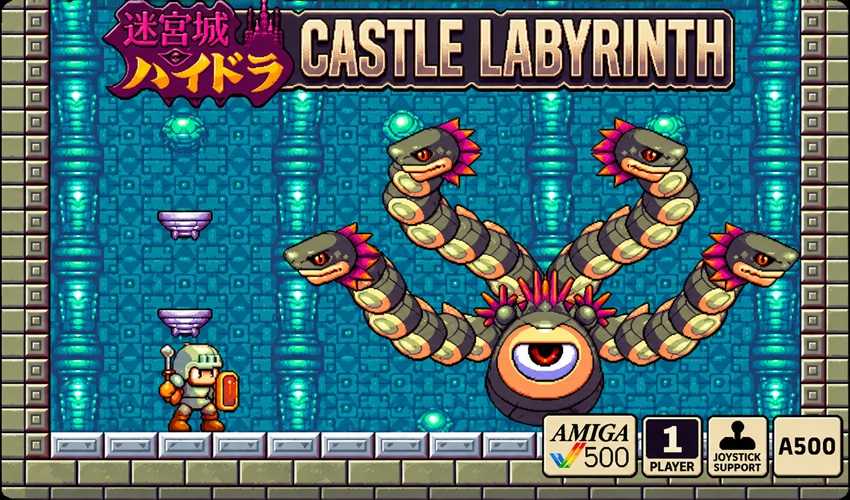
There’s something irresistible about a game willing to hand you a sword, drop you inside an enormous castle and leave the rest to your curiosity. Hydra Castle Labyrinth does precisely this, and now IcarusLab has brought the Japanese action-adventure to the Commodore Amiga 500. Better still, it runs on a standard 7 MHz Motorola 68000, boots from a single floppy disk and doesn’t demand expensive hardware upgrades. It’s the sort of release capable of grabbing my attention immediately. No complicated premise. No lengthy explanations. There’s a castle full of monsters, hidden passages and useful equipment, and your job is to work your way through it. Simple on paper, wonderfully demanding in practice.
A Japanese adventure with plenty of character
Hydra Castle Labyrinth started life as Meikyuujou Hydra, a freeware Windows game created by Japanese developer E. Hashimoto, better known as Buster. Inspired by classic action-adventures such as The Maze of Galious, it combines platform combat with exploration, puzzles and a castle packed with interconnected rooms.
What makes this formula so appealing is its refusal to hold your hand. You’re expected to explore, experiment and remember places you can’t reach yet. Finding a locked passage or an inaccessible platform isn’t necessarily a dead end. It could be a clue for later. And I love games built around this idea.
There’s a particular satisfaction in discovering an object and suddenly understanding its purpose. A difficult section starts making sense. A previously inaccessible route becomes your next destination. Hydra Castle Labyrinth builds much of its progression around these moments, giving exploration as much importance as fighting enemies.
An Amiga conversion with serious technical ambition
The Amiga edition comes from IcarusLab, using open-source code maintained by ptitSeb as its foundation. Rather than running the Windows original through emulation, this is a native conversion created for Commodore’s hardware.
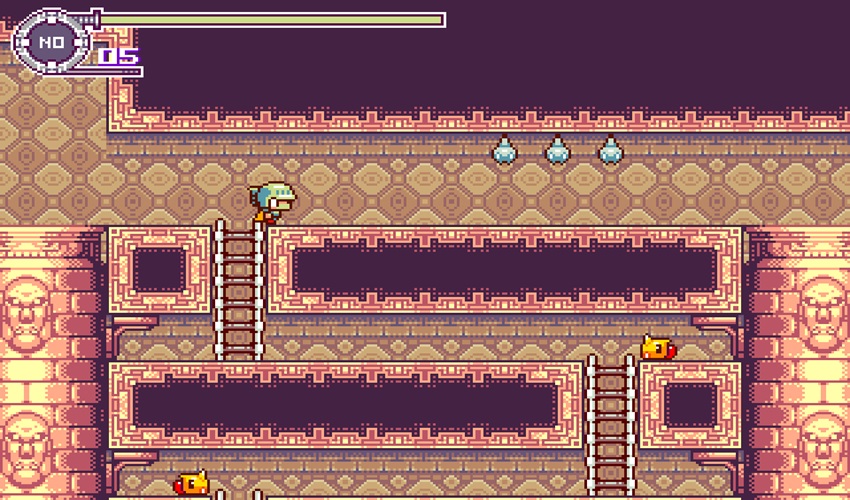
Everything fits onto one 880 KB floppy disk image. There’s no need for Workbench or a hard drive. Insert the disk, boot the machine and you’re ready to start exploring. Underneath its colourful pixel graphics sits some interesting technical work. The knight uses Amiga hardware sprites, enemies are handled through the blitter, and the display targets 50 Hz PAL output..
A sword is only the beginning
At first, our armoured hero has little more than his sword and the ability to jump. It’s enough to get started, but the castle soon makes its expectations clear. You’ll need more than quick reactions to reach its deeper sections. Equipment changes everything.
Special boots provide a double jump, pickaxes break certain blocks, and protective footwear allows the knight to cross lava. Each discovery gives you new possibilities, encouraging another examination of previously visited areas.
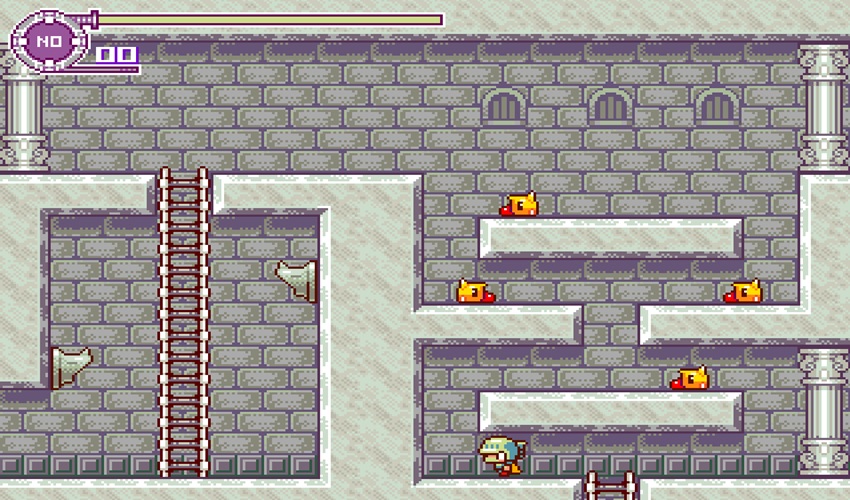
Naturally, the castle isn’t empty. Slimes, bats and hostile knights populate its chambers, with larger bosses guarding important sections. Combat relies on the trusty sword and selectable sub-weapons, keeping the action moving between periods of exploration. Keyboard, joystick and CD32 pad controls are supported. A two-button joystick separates jumping from sword attacks, a welcome arrangement for a platform adventure where timing matters.
A complete adventure, with a few rough edges
The entire game is playable, though the conversion isn’t without limitations. Sound effects are included, but background music is currently missing. Saving progress to floppy isn’t available either, making longer sessions a serious commitment.
I can’t pretend those omissions are insignificant. Music adds personality to an adventure, and saving becomes particularly useful in a game built around extended exploration. Still, neither changes the central attraction: a complete castle to investigate, enemies to defeat and equipment to discover. Hydra Castle Labyrinth is distributed as a name-your-own-price ADF download under the GPL-2 licence.
For me, the exciting part is seeing a substantial action-adventure adapted for an ordinary Amiga 500 rather than demanding a heavily upgraded machine. It’s a straightforward proposition, but an appealing one: one floppy, one knight, a huge castle and plenty of reasons to explore another room.
MORE AMIGA & RETRO NEWS
 Classic DOS shooter Ken’s Labyrinth arrives on Amiga
 41 years of Commodore Amiga: 41 facts about the legendary computer
 Why X-Copy was brilliant, controversial and impossible to forget
 The Commodore A590 hard drive: when the Amiga 500 became a serious computer
 The forgotten PS1 floppy drive that backed up PlayStation memory cards
 The Acorn Risc PC’s multiprocessor dream: Hydra, extra CPU cards and RISC OS reality
 Amiga beyond Commodore: how outside companies built its gaming, video and software legacy
 The Japanese computer that beat IBM at home: inside the NEC PC-98
 How Verbatim, Maxell, Sony, and 3M fought to own the floppy disk era
 The adventure of Node preview: Bad Pun Studio’s Zelda-inspired Amiga quest
 Broken Sword’s long road from 1990s PC classic to possible Hollywood film
 50 Amazing games you can play on AmigaOS 4 and AmigaOne computers
 50 Classic Commodore 64 games that made the C64 the king of 80s gaming
 The 50 best Amiga games of all time: a nostalgic journey through the Commodore era
 Amiga 880KB disk format explained: tracks, sectors, and engineering choices