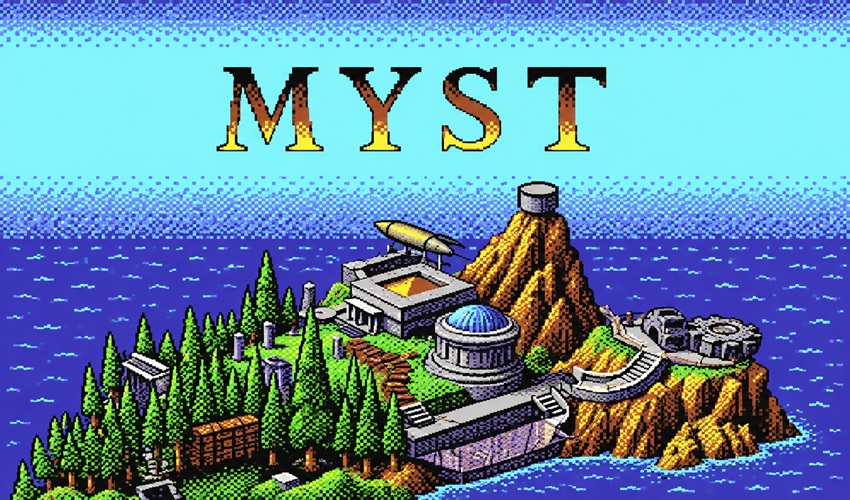
Some games never quite leave your mind, and Myst is one of them. Its deserted island, peculiar machines and mysterious books made it unlike almost anything else in 1993. I still find the idea of playing it on a Commodore 64 wonderfully absurd. Yet here it is. Myst 64REU brings Cyan’s famous adventure to the 8-bit computer, complete with its puzzles, locations and multiple endings. And no, we’re not talking about a small demonstration or a handful of recreated screens. This is the actual adventure, squeezed into a machine released eleven years before Myst first appeared. There’s a catch, of course. You’ll need a 16 MB RAM Expansion Unit. But considering the original game arrived on CD-ROM, I can live with a little extra hardware.
Myst was never supposed to run on a Commodore 64
When Cyan released Myst for the Apple Macintosh in 1993, it offered something rather different. Brothers Rand and Robyn Miller created an adventure with no conventional combat, no frantic action and very little explanation. You arrived on an apparently deserted island and started investigating. Every switch, strange building and handwritten note seemed to mean something.
I love how Myst expects you to pay attention. A sound might provide a clue. A book could change your interpretation of events. And occasionally, after spending far too long staring at a machine, the answer suddenly becomes obvious.
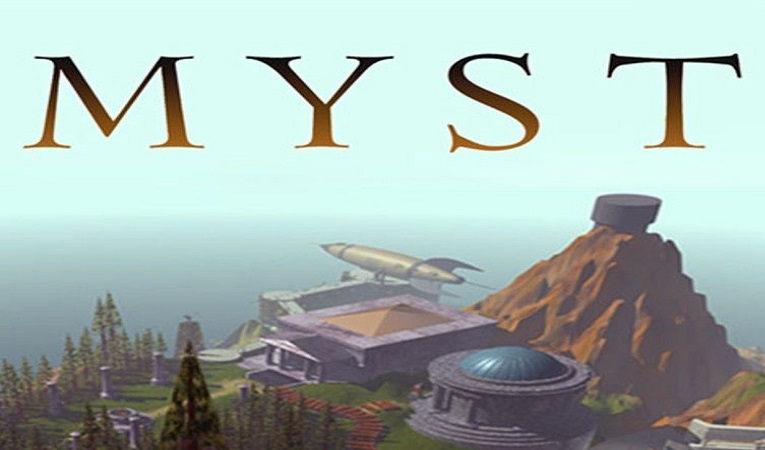
Its pre-rendered graphics and recorded audio made excellent use of CD-ROM technology, helping Myst become one of the defining PC adventures of the decade. The Commodore 64, released in 1982, belonged to a completely different generation of home computers. Which makes this conversion particularly interesting.
The entire adventure, not a miniature remake
Developer Max Smith, releasing the project as CordySmith, has taken the original Macintosh HyperCard material and converted it into a playable C64 edition. The project is unofficial, non-commercial and developed with AI assistance. The important detail is how much survives the transition.
Myst 64REU includes six areas, covering Myst Island and the worlds connected through its mysterious books, right through to D’ni. The familiar machinery remains, along with the puzzles, journals and red and blue pages. Atrus, Sirrus and Achenar are still central to the story, and your decisions still determine the ending.
That’s impressive in itself. You explore through static screens, clicking objects and moving between viewpoints. It’s the same basic approach used by the Macintosh original, so the experience makes sense on the C64.
There’s support for a 1351 mouse, joystick and keyboard. The keyboard uses I, J, K and L for pointer movement, with the space bar handling selection. A Macintosh-style desktop provides access to the game menus, and there’s a magnification option for reading books and small signs.
The graphics have undergone a serious transformation
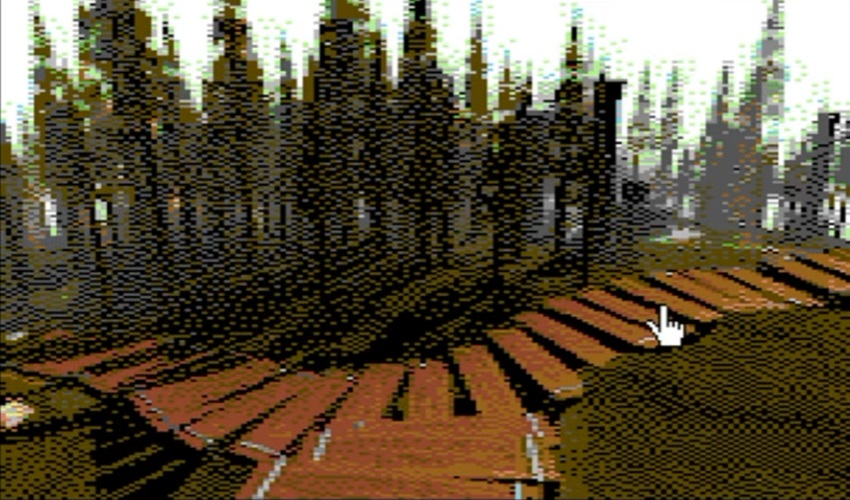
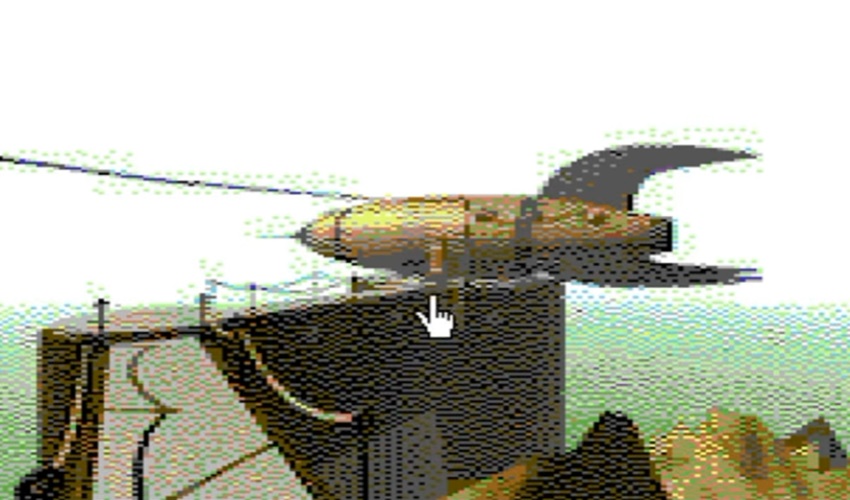
Myst’s original artwork relied on detailed, pre-rendered images. Translating those scenes into the Commodore 64’s limited colour palette isn’t a simple matter of reducing their resolution. Myst 64REU uses multicolour graphics and dithering to represent the original environments. Certain screens have been adjusted or enlarged to keep important details readable.
Naturally, the result can’t resemble a Macintosh displaying thousands of colours. But I find the technical approach fascinating. There’s something satisfying about seeing familiar Myst locations represented through the unmistakable graphics of a C64.
The sound conversion is equally interesting. Instead of replacing the original recordings with conventional SID compositions, the game plays digitised audio samples through the Commodore’s sound chip. Short loops recreate ambient effects, and scenes originally featuring video conversations use still images accompanied by captions. It’s a compromise, certainly, but one intended to retain the clues and information required to finish the adventure.
Why Myst needs 16 MB of extra memory
The Commodore 64 originally shipped with 64 KB of RAM and a processor operating at approximately 1 MHz. Myst was developed for a considerably different computer environment, with CD-ROM storage providing room for its images and recordings.
The 16 MB REU changes what’s practical. It supplies extra memory and uses direct memory access to transfer information into the C64’s main RAM. Without a compatible expansion, Myst 64REU won’t run. The release requires a PAL Commodore 64 equipped with a 16 MB REU, or the VICE emulator configured to provide one.
A playable Myst conversion with a few rough edges
Released on 19 November 2026, Myst 64REU is currently available as a download of approximately 13 MB. It’s still a development release, and Smith has completed full play-through testing in emulation rather than confirming a complete run on original hardware.
Audio behaviour can differ between SID configurations, with settings provided for the 6581 and 8580 chips. For me, the most exciting part isn’t simply the amount of data fitted into an 8-bit computer. It’s seeing such an unlikely combination become a complete, playable game. Myst and the Commodore 64 were never obvious companions, yet their different approaches to computer entertainment meet here in a surprisingly practical way.
I wouldn’t trade the original Macintosh release for it. But I’m very glad this version exists. There’s something genuinely exciting about discovering Myst has found its way onto the C64, over three decades after its debut.
MORE AMIGA & RETRO NEWS
 What if Commodore had abandoned everything except Amiga?
 41 years of Commodore Amiga: 41 facts about the legendary computer
 Before Hackintosh, there was Brazil’s forbidden Macintosh clone
 When Commodore tried to turn the C64 into a console, it backfired spectacularly
 New amazing C64 Ultimate game engine explores 64 MHz power and REU memory
 C64 Studio 8.4 strengthens retro programming for Commodore 64 developers
 A LucasArts classic sails onto PS1 with The Secret of Monkey Island port
 ZX Spectrum and Commodore 64 are back: new hardware, old rivalry and a growing market
 Harald Speyer: the forgotten executive behind Commodore Europe
 How the Power Macintosh 4400 revealed Apple’s 90s identity crisis
 The Secret of Monkey Island history: development, success, and lasting legacy
 The hidden business strategy behind the Commodore 64’s success
 50 Classic Commodore 64 games that made the C64 the king of 80s gaming
 Retro revival: The Secret of Monkey Island is being developed for the Commodore 64
 Myst: One of the best-selling Amiga & PC games of all time